
← The upEND Podcast
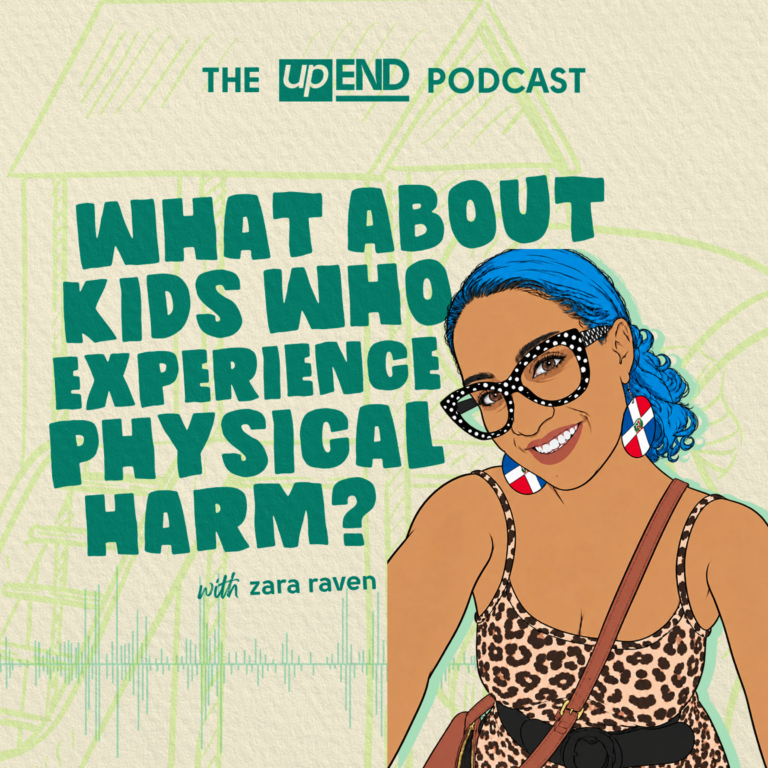
What About Kids Who Experience Physical Harm? (with zara raven)
Season 3, Episode 6

We can build a society where children and families are strengthened and supported, not surveilled and separated. The upEND Podcast illustrates that the “child welfare” system is beyond reform and needs to be abolished. The only solution to ending the harm of what we name the family policing system is a fundamental reimagining of the way society cares for children and families.
Josie and Jaison sit down with care worker and healing justice practitioner zara raven to explore how communities can protect children from physical abuse without turning to family policing or other harmful systems. Drawing from lived experience as both a survivor of harm and the system, zara shares how collective care networks can model real safety that is grounded in trust, accountability, and community connection. Together, we imagine what it means to keep kids safe through care, not control.
About Our Guest:
zara raven is a Mad Caribbean queer care worker, healing justice practitioner, and zinester based in Philadelphia on Lenapehoking land. A survivor of both state and interpersonal violence, zara organizes toward collective safety through care, not punishment. Their work includes coordinating Queenie’s Crew, an abolitionist education program for children and youth, and helping rebuild the Philly Childcare Collective, a mutual aid network providing childcare rooted in trust, accessibility, and political education. zara’s work reminds us that abolition isn’t the absence of safety, it’s the presence of care, accountability, and connection.
Episode Notes:
Support the work of upEND: upendmovement.org/donate
Episode Transcript: upendmovement.org/podcast/episode306
Read “Reclaiming Safety”: upendmovement.org/safety
Josie mentions the work of Montrose Grace Place and the documentary A Vision of Gracethat the upEND team produced with the youth there.
Mad Maps is a wellness tool created by Fireweed Collective.
zara names many organizers that they are inspired by, including Bay Area Child Care Collective, Philly Community Bail Fund, Freedom Side School.
We discuss the concept of Pod mapping, citing the Bay Area Transformative Justice Collective and Mia Mingus.
Learn more about zara’s work at relearningrelationships.xyz.
Episode Description
Josie and Jaison sit down with care worker and healing justice practitioner zara raven to explore how communities can protect children from physical abuse without turning to family policing or other harmful systems. Drawing from lived experience as both a survivor of harm and the system, zara shares how collective care networks can model real safety that is grounded in trust, accountability, and community connection. Together, we imagine what it means to keep kids safe through care, not control.
About Our Guest:
zara raven is a Mad Caribbean queer care worker, healing justice practitioner, and zinester based in Philadelphia on Lenapehoking land. A survivor of both state and interpersonal violence, zara organizes toward collective safety through care, not punishment. Their work includes coordinating Queenie’s Crew, an abolitionist education program for children and youth, and helping rebuild the Philly Childcare Collective, a mutual aid network providing childcare rooted in trust, accessibility, and political education. zara’s work reminds us that abolition isn’t the absence of safety, it’s the presence of care, accountability, and connection.
Join the conversation!
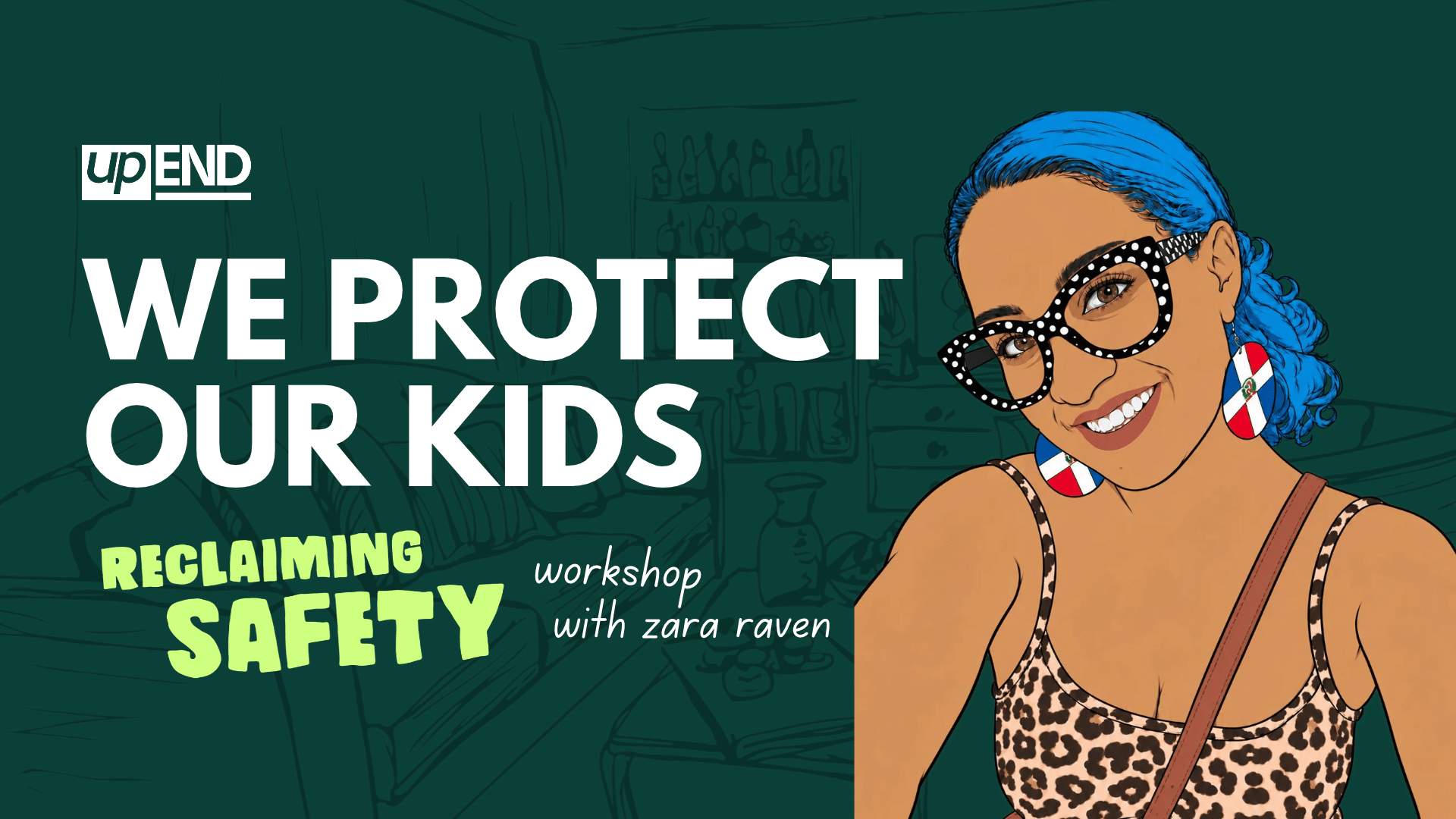
zara raven is leading a workshop on November 10, 2026. They will be able to answer your questions about creating safety for children and we’ll work through some scenarios together.
Learn More
Reclaiming Safety is upEND’s exploration of frequently asked questions about family policing abolition. This episode is an accompaniment to the essay Reclaiming Safety for Children Who Experience Physical Violence by Zaira Campos.
Episode Notes:
- Support the work of upEND: upendmovement.org/donate
- Episode Transcript: upendmovement.org/podcast/episode306
- Read “Reclaiming Safety”: upendmovement.org/safety
- Josie mentions the work of Montrose Grace Place and the documentary A Vision of Grace that the upEND team produced with the youth there.
- Mad Maps is a wellness tool created by Fireweed Collective.
- zara names many organizers that they are inspired by, including Bay Area Child Care Collective, Philly Community Bail Fund, Freedom Side School.
- We discuss the concept of Pod mapping, citing the Bay Area Transformative Justice Collective and Mia Mingus.
- Learn more about zara’s work at relearningrelationships.xyz.
Credits:
- Hosted by Josie Pickens and Jaison Oliver
- Produced by Sydnie Mares
- Mixed by Imani Crosby
Transcript
Jaison Oliver
Welcome to The upEND Podcast, where we imagine a world beyond family policing. This episode is a companion to upEND’s Reclaiming Safety essay series, where we explore what real protection looks like when we move away from surveillance and punishment and toward community care. Today, we’ll talk about how to support children who experience physical abuse in non-carceral community-centered ways and what it takes to keep young people safe without relying on systems that harm families. Joining us is zara raven whose work builds collective networks of care to keep children safe through connection, accountability, and love. Welcome, zara.
zara raven
Thank you so much for having me.
Josie Pickens
We’re so excited to have you here and I want to offer a little bit of background on zara. So zara raven is a mad Caribbean queer care worker, healing justice practitioner, and zinester based in Philadelphia on Lenapehoking land. A survivor of both state and interpersonal violence, zara organizes toward collective safety through care, not punishment. Their work includes coordinating Queenie’s Crew, an abolitionist-centered education program for children and youth, and helping rebuild the Philly Childcare Collective, a mutual aid network providing childcare rooted in trust, accessibility, and political education. zara’s work reminds us that abolition isn’t the absence of safety, it’s the presence of care, accountability, and connection. So again, thank you so much for joining us today, zara.
zara raven
Yes, thank you so much for having me.
Jaison Oliver
All right, let’s get into it. So zara, you have lived through harm both at home and through family policing. How did surviving those experiences shape how you understand safety? And how did those experiences bring you to the work you do now to build care networks for children?
zara raven
Yes. I think that my experiences helped me recognize that safety is created. It’s something we have to put intentional time and effort into building proactively. Safety is not some magical destination out there. It’s something we practice and refine here and now, day in and day out.
So I think that being separated from my family showed me that the state doesn’t have some magical place where they can keep kids safe, doesn’t have much of a plan for where kids can go. I think that when people make the call to have the state intervene in that way, they imagine that there are resources out there that aren’t actually out there.
In my case, I had two siblings. We were each sent to separate homes. My sister was sent to a friend’s house. So the network of care that was there, it was already people that we knew, at least for her. And then I was sent to live with distant relatives in another city in New York. I had been living in Jersey. And then my younger brother had been sent to a foster home with strangers. And then like even for me in that first year, I made like five different moves. And then in the second year, I was sexually assaulted. So it wasn’t like there was some safe place that I was going to go.
But then also keeping me isolated in a home with an abusive parent wasn’t gonna help me either. Isolation is one of the main conditions that leads to abuse. So I think if we hadn’t been isolated, we would have been safer. But also around any home that we were in is this larger cultural context that supports abuse. And I think that’s another piece of the puzzle, that the belief that children are property to be seen and not heard, and that disproportionately impacts disabled kids and especially Black disabled kids and kids of color. So I guess my answer is that I’ve always needed collective networks of care. I needed them for myself when I was a child, but also for myself as a single parent for the last 11 years. And as someone who doesn’t already have a built-in family network that I lean on for support, I always had to do the work of creating the networks of care that I needed with my neighbors and with my friends and with people that I could build with.
Josie Pickens
Thank you for that. I’m already, my mind is already turning with what you’ve offered even in just your experience as a child and even your experience as a parent. And we have to acknowledge that harm happens and think about how we address that. So when harm happens, especially physical abuse, the instinct for many people is to punish, right? Like that’s what we’re taught. That’s that carceral logic that is kind of instilled in us at a very, very early age. But abolition teaches us that accountability can take different forms such as repair and transformation. What are some concrete ways community can hold adults accountable for harm without turning to shame and fear and punishment?
zara raven
I think we have to be proactive. I think we have to, we can’t wait for harm to happen to have systems in place that are actively working to create safety. When harm reaches the level of abuse, I think you’re already in crisis mode with safety planning or self-defense. So for me, I want to be involved in everyday conversations about safety and connection and care and grief. So a lot of the restorative justice circles I facilitate are actually not even responses to harm. They’re planning circles to have a space where we talk about how we’re connecting.
The last circle I had in my care pod, our Libra season circle, was like fall planning. It was talking about what does shared care looked like for the next three months, what went well, what in the period of time since our last circle, what didn’t go well, what do want to change? We also tend to grief in those circles and that was a big topic at our last circle. We made a grief tree because two people who had been part of my care pod are no longer part of the care pod and it’s very different now and so we wanted to honor that transition and create a space for both us as adults and for the kids to tend to their grief around that transition. So what I’m describing is building an accountable community that can navigate conflict and harm on a day-to-day basis so we can identify misalignments, figure out how to separate from each other if a situation becomes severely harmful.
You know, I’ve tried so many ways. I’ve had so many different strategies for navigating abusive situations over the course of my life. It’s always been front of mind for me having grown up in an abusive home, but also being a survivor of domestic violence, replicating the same kinds of experiences I had as a child, I replicated in my adult relationships. I’ve tried to stay in relationship with people behaving abusively in an attempt to support them and mitigate the impacts of their behaviors, especially on children and that has ended disastrously for me. I don’t know if that was the best thing I could have done. I’ve organized to interrupt abusive behavior and that created some short-term changes, but I’m not actually sure that it led anyone to do deep internal healing and self-accountability work. So I think there is this piece for me of like, I actually, I don’t know that anyone knows.
But what I have found repeatedly has been the best way to navigate situations where someone’s behaving abusively are keep the focus on the needs of people who are being abused. Focusing on safety, focusing on what does everybody need. Keeping good boundaries. I think people behaving abusively. And I use abuse, I think that it’s tricky.
When I’m describing abuse, I’m talking about a pattern of systematic power and control seeking behaviors. So I’m not even talking only about physical violence. Physical violence, I think, can be situational. It can be, I am stressed out, I’m getting no help, I’m exhausted, I don’t have the resources to take care of all my needs and all the people that depend on me, and I am beyond my limit and I’m acting out of alignment with my values. That could be situational violence, or those kinds of circumstances could lead to situational violence. And I don’t necessarily think of that as abuse because the ways that you respond to that situation is making sure that people have everything they need to be safe. Housing, resources, collective care, help. So I think that’s probably a lot of situations. People just need basic resources to stay safe.
But then when I think of abuse as a series of power and control seeking behaviors, a lot of that is rooted in entitlement, it’s rooted in beliefs of certain groups of people are not entitled to the same level of care and respect and safety as I’m entitled to. And that shows up because of adultism, that shows up because of patriarchy, that shows up because of anti-Blackness and colorism and ableism, all of these different intersecting systems of oppression that lead people to, the way I describe it is it’s like, colonization on the interpersonal level where you’re seeking to diminish the personhood of someone else and extracting labor, extracting while diminishing, and physical violence is one of the many strategies that’s used to maintain that power and control dynamic.
In those situations, I think you have to keep good boundaries because otherwise you end up getting sucked into that person’s world and people who are behaving abusively, they make it, it’s really easy to get sucked into focusing all of the attention on them and continuing this pattern of neglecting the needs, feelings, and experiences of the people most impacted by their behaviors.
So where I’ve landed now is, and part of this too, it comes from my training now as a mental health care worker. A lot of times I think something needs to change in someone’s life for them to be ready to change. We can’t change people. We can’t determine the timeline on which they change. And it’s, I think, even presumptuous to believe that everyone, everyone we love is going to change in the direction that we want them to change.
So again, keeping really good boundaries with people while supporting those impacted by their behavior for me has been the best way to navigate abuse. I don’t shame them. I don’t punish them. I just say, I don’t fuck with that. And if that’s what you’re doing, you could do that over there. And I focus on creating conditions that promote safety because I’ve spent so much of my life really like pouring into people who were mistreating me and that’s not how I want to spend the rest of my life.
Jaison Oliver
I’m sitting with that and thinking about, you know, just stuff that’s coming up for me in terms of the community building work I ran into just last weekend, actually, a friend of mine who runs this restorative justice organization in Houston. And she was just doing some arts workshops, just some creative workshops at this market coffee shop thing in Houston. I just happened to run into her as I was going about the neighborhood. And we got a chance to chop it up and make a little bit of art and hang out for a bit. And she also does monthly community circles where we’re able to just come together and hang out. So yeah, that work beforehand. Of making sure that we have the relationship that we need. So that when the hard stuff comes that we’re able to try to start working through it.
zara raven
I love that.
Josie Pickens
And I’d also like to add, if I can, I love your answer of “there are so many answers.” One thing that stands out for me when I always think about Mariame Kaba and how she addresses this question around abolition, where it is this idea that as abolitionists, we’re supposed to have very clear, direct answers on how to address the harm that we experience in systems, right? And her response is, well, I don’t know what it is, but I know it’s not this. I know what we need is not this. And I think that that is such a powerful starting point. And then even the idea of like a million experiments. We’re just experimenting to see what sticks and what works. So I really love the journey that you took us on, your personal journey and how that impacts your work and how that is making me think more deeply about communal response.
zara raven
Yes, oh I appreciate that. Yeah, because all of us are not going to have the same ways of responding either because of our own experiences. Maybe it’s too raw. Maybe we’re too tired. You know, I might have a different answer in 10 years.
Josie Pickens
Right.
zara raven
So yeah, I appreciate you reflecting that back and both like there are just so many ways to respond. And also Jaison, what you said about how much of restorative justice work is doing art and monthly circles. Time to get together. Yes.
Jaison Oliver
Something you had started talking about are these interlocking systems of oppression that shape how families are treated when they seek help or want to heal from harm. How do you see these overlapping systems impacting the way children and families, particularly Black, Latine, queer, and trans families, are treated when they’re dealing with these more heightened instances of physical abuse that we tend to pour a lot of our attention to both in their communities and within the family policing system.
zara raven
First off I think even how abuse gets defined ends up being so arbitrary and so shaped by all of the oppressive systems that you named racism, sexism, homophobia, transphobia… I would add ableism to the list. So parents with psychiatric disabilities are eight times more likely to have contact with the family policing system and 26 times more likely to have children removed from home.
So abuse becomes, these folks are ill-equipped to provide care for kids because they’re disabled. So the ways that we define the terms, or that the state rather defines the terms, I don’t define it that way. But the ways that the state defines the term abuse becomes shaped by these oppressive systems.
Also, for example here in Philly, I connected with a family who sought to access gender-affirming care for their trans kid and staff at the hospital reported them for that. And I connected with another family where there was a parent who wasn’t supportive of their trans kid. So it was the partner of the parent that I spoke to in accessing gender affirming care and staff at the same hospital reported them. So again, it’s just, it’s so arbitrary.
Jaison Oliver
Hmm, damned if you do, damned if you don’t.
zara raven
Right. It just depends on who you might be encountering and what their beliefs are. But I think with Black and Latine, queer and trans, and disabled kids in particular, they’re so often cast out of the family network. A number of studies, including a study by the National Network for Youth have shown that up to half of young people experiencing homelessness are queer and trans kids and the vast majority of those are Black and Latine. And if we’re accounting for trauma as a disability, I’d argue that 100% of them are disabled. And many of these young people have been abused or kicked out or have run away from families of origin where they were rejected for their queer or trans identities or for being different and not able to conform to ablest heteronormative ways of being.
And they haven’t been kept safe in the family policing system either. So that’s how so many young people end up on the street. That was my experience. I ended up running away from one of the homes that I had been in and decided after being moved around so many times and recognizing that safety wasn’t being offered to me, decided to hack it on my own when I was 15. And at the time, and for many years after that, I thought, this was just my experience it didn’t work for me. And then later on, saw the data that showed that actually my experience was incredibly common among Black and Latine, queer and trans kids.
Josie Pickens
That’s so good and I feel that. Here at upEND, we’ve been working with a local organization in Houston called Montrose Grace Place and the work that they do is specific to mostly Black and brown, queer and trans youth who are experiencing housing insecurity. There’s one thing to read the statistics and to read those papers. And then there’s another thing to see it happening in real time. We created a short documentary called A Vision of Grace that focuses on youth from Montrose Grace Place. It’s a beautiful film, if I must say so myself, that we made that really centers these youth and their work around trying to change and transform their lives and the lives of other youth like them. So yeah, those numbers and statistics are staggering and they are, and it’s only the beginning, you know, it’s only the beginning of that story.
zara raven
Hmm, I would love to see that documentary. That sounds awesome.
Josie Pickens
We would love to show it to you and if you would like to in the many projects that you’re a part of…
zara raven
Yeah, I mean we’re always doing political education in the child care collective. Sorry I cut you off.
Josie Pickens
No, no, no, I was just going to say we have viewings…
Jaison Oliver
We know a guy.
Josie Pickens
We’d love to create a viewing with you. So just let us know. I guess we should move along with the questions. We’re like yeah, we should totally get together offline and talk about these things because it is related and we’re such fans of your work and these projects that you lead.
zara raven
That sounds awesome! It’s relevant, it’s related. Thank you.
Josie Pickens
We know that you’ve led projects that really put abolitionist safety into action, as we’ve been talking about, from caregiver circles to pod mapping. Really, really love the pod mapping and especially your desire to teach kids pod mapping, which I think is so, so important. Like I think even when I think about my own pods as an adult. I wish these were lessons that I would have learned in my youth. So just preparing you to think about who can I lean on for care and support is so important. What strategies have you found most effective for keeping children safe and supported without calling CPS or police? What does proactive safety planning look like on the ground?
zara raven
Yeah, I appreciate that you brought up pod mapping. Now, like with my daughter, we revisit her pod map every year. So we actually just did it at the start of this school year. And it’s just, it’s become so natural and easy for her to start thinking about because we’re thinking about it year round. So by the time we’re revisiting the pod map, we’re just writing it down and we have it up on the fridge, but I think it’s really that. It’s just having collective networks of care that we can lean on, and being in constant communication with folks about what our needs are, which also means being in constant communication with ourselves about what our needs are, so that we can meet those needs for each other.
I think coming back to building accountable communities, starts with building our own capacity to be accountable. So outside of pod mapping, my pod, we do care maps, which are kind of like Mad Maps. If y’all are familiar with Mad Maps, it’s a wellness tool. I learned about it through the Icarus Project, which is now known as the Fireweed Collective. But it’s a tool to map out how we want to, how we keep ourselves well on a day-to-day basis and how we want to respond when we’re experiencing a mental health crisis. And so everybody in my pod is disabled and so we like to have our care maps for ourselves and each other and we make them as zines and we put our pod maps in them.
But the care map, I think, helps us on the day to day, just being like, what are my daily needs? What are the daily things that I do to keep myself well? What are the signs that a crisis is oncoming? And then we share them with each other. I helped my daughter create one where we list her safe foods and similarly, what are the things, what are the warning signs and what are the things that might lead her into, I don’t think we call it crisis in that actually, what might trigger her.
And her list, it’s things like not being listened to, not being respected. So it is just the experiences of adultism that she has in her daily life, just being made to feel invisible, that’s a big trigger for her. But just being able to talk about it and write it down and share with each other, I think that those are ways that again, we can be proactive before harm happens to keep kids safe. And yeah, I think this model is very different from the approach of the criminal legal system, which is past oriented. It focuses on punishing harm. Transformative justice is future oriented. So instead of asking like, who will be punished? We’re asking, what do we need to do to keep each other safe? So we’re looking towards the future.
And then the other, when you asked what strategies I found most effective for keeping kids safe, I think of the child care collective. In the child care collective, we don’t require criminal background checks or child abuse clearances. We don’t assume that someone’s history of criminalization makes them a safe or unsafe person to be around kids. Instead, we know collective care keeps kids safe. So for example, we require two providers to be on every single shift. Even if only one kid is signed up for child care that day. So we have to actually be thoughtful about what our policies and practices are since we’re not just relying on having a history of criminalization. We have a bathroom policy which we borrowed from or adapted from the Bay Area Child Care Collective.
For example, we won’t change diapers without explicit consent. We won’t have a child in the bathroom alone with a single provider. So we’ve had to have all of these conversations about how we actually promote safety for kids. Another thing that we do now is we prioritize long-term relationships. So the way the Child Care Collective works is we partner with local movement groups like the Philly Community Bail Fund or the Freedom Side School and when they have an event they can contact us and then our members can provide child care.
So we try to focus on having a few long-term partners and that way we can build long-term relationships with kids and their parents and the groups that work with those folks. And I see long-term relationships as a strategy for promoting safety for kids without calling the cops. So I think we’ve just had to be really specific, really intentional, really thoughtful. We do debrief forms after every childcare shift too, so that if something comes up, we have a people committee, I’m on the people committee. And so if something comes up on a shift, there is a way to communicate that and then a way to think through, okay, what are the processes we’re gonna need to build to prevent something like this from happening in the future and what are the skills we need to have to respond to this kind of situation in the future?
So we’re getting ready to have a bystander intervention training in November so that all of the members are skilled up in that way so that if something comes up… like something that came up on a shift, we did a shift at a bar over the summer. It was like a beer garden. And so we were encountering things that we had never encountered before. Cause we’re usually in a school or a church basement or something like that. But we were at a beer garden and there was a drunk man who was really close to our kids space, wanted to grab the bubbles, was playing with the kids. And so a few of the members providing childcare felt pretty uncomfortable, weren’t really sure how to navigate it. And so we have the debrief form so that we can say, okay, this is what happened, this is how we felt. These were the questions we were having. What is the child care collective’s response? What are we going to do? And we can have intentional conversations so that we can adapt as situations arise, but be in constant communication about promoting safety.
Josie Pickens
Oh, all of that is so good, zara. And all of it is mapping, right? Now, I would like, because as I was sitting here listening to you, I’m thinking, well, what if one of our listeners or some of our listeners might not understand what mapping is, and particularly what pod mapping is? Could you give us a… an idea or a definition of that? And then we also want to talk about Queenie’s Crew because wow. And all of this, this pod mapping, your work, and vision with Queenie’s Crew is all about how we can better listen to what kids need and really center their participation in conversations around safety. So if you could join those things together if it won’t be too hard. I feel like they’re all connected, right?
zara raven
Yes, definitely. Mapping is really brainstorming and writing down the resources that exist in a community or the needs. Pod mapping comes from the Bay Area Transformative Justice Collective and specifically Mia Mingus. And it’s a worksheet with a large circle in the center. In the center you write your own name and then there are circles around where you will write who are the people that I will turn to for support in a given situation and then on the outside are larger circles that ask what are the resources in my community that I can turn to for support and you can have different pods for different experiences. The people that you might lean on for support for co-caregiving, for example, might be different from the people that you lean on for support in a situation where you have caused harm and you want support to be accountable. So you can have different pods for different situations.
And ideally you would talk to those people about what the role is, what the expectations are, what the needs are. You might be on someone’s pod and have them on your pod.
And let’s see. So, yeah, so we started doing them in Queenie’s Crew. I worked with an artist, Bianca Diaz, who also illustrated Mariame Kaba’s book, the children’s book, See You Soon. So Bianca was an amazing partner on all things Queenie’s Crew. And so we just made it more colorful, honestly. And I’ve actually heard from a lot of adults that they like using our colorful version.
Josie Pickens
I know I want to print out a copy and use it. It’s helping me think about my own pod mapping. So, yes.
zara raven
I love that. Yeah, it’s just fun. It’s just accessible. I love doing pod mapping. Usually I think it’s caregivers are doing pod mapping with their kids. So I pod map with my daughter each year. And like I said, every year it gets easier, because we’re always actively thinking about those questions of like, who are our people?
And the more proactive I am in thinking and talking about it the more I’m deepening relationships with people who are actually interested in building relationships with my daughter. So like I have two friends Kay and Val who set up these quarterly dates with my daughter and now have a little group chat with her. I feel like I have so many folks in my life because now it’s just an ongoing… and this wasn’t always my life. I became a single parent, alone, 11 years ago. Had this vision of communal care, had a spreadsheet because I’m a Taurus moon and I was like okay this is who’s helping this time but I was still responsible.
And I’m still ultimately responsible but it doesn’t feel as much as if everything falls on me now that I have a more intentional community of care. And I think some of that is really building relationships with other disabled, queer and trans parents of color, rather than hoping or expecting that my childless friends were gonna step up in the ways that I needed when I lived in a very different life than they did. And so, yeah, so I think I’m getting off track. I don’t even remember the question.
Josie Pickens
No, no, no, you’ve answered it beautifully and in all the ways, especially talking about making sure that children are participating and are centered in these kinds of conversations around safety. I feel like it’s empowering all the way around. It’s empowering for those children. It’s empowering for the parents to just have answers.
Like, if I know that if I need something, if I need this, I know I can call this person. I know if I need this, that has to, I know for myself because I’ve been working on my own pod mapping. Also, it makes you feel very grateful. Like, these people, I know these people would show up for me and care for me in these ways. So it’s a great combination of all of those things. And yes, you answered the question beautifully.
zara raven
Thank you. You reminded me. I wanted to add to the piece about centering kids in these conversations. I think it’s really just about listening to kids year round, not just about safety, but about their interests, their crushes, their mistakes. We have to actively show kids that it’s safe to talk to us about what’s going on in their inner worlds. Even if they’re like my daughter and they want to teach you a very elaborate K-pop choreography situation. Showing interest in their lives and kids are so creative and imaginative. And so I think as adults, we can pause more and know that there’s so much that they can teach us if we’re willing to listen about creating safer communities and about relationships and even just living authentically.
Jaison Oliver
So does that mean that you know what six seven means?
zara raven
My god, I actually… so we have a theory. Six seven originated in Philadelphia. So my daughter’s theory is that it comes from the 267 area code. But when asked to define six seven, she said, “idk brain rot.”
Josie Pickens
Nobody knows. No one has a specific and exact definition and I need one. Everyone I talk to about it has a different definition. I don’t think I’ve asked my daughter yet. I need to do that right after this.
Jaison Oliver
Well, thank you for that. For our listeners, you heard it here on The upEND Podcast. First, we talk about the heavy hitting issues. Six seven. But yeah, I appreciate that around centering kids and really listening to them at all times. And creating a space for them to really speak about what they’re experiencing, even if it might cause our own brain rot.
zara raven
Right.
Jaison Oliver
That creation of safety that we see through that process, your work shows us that that isn’t something that the state can give. The state is not going to be able to answer that question for us. Or the questions about how we really deal with the major challenges that we’ve seen. They haven’t done it yet and they are not moving us in the right directions. It’s really something that we build together through practice and through care. So as we imagine a world where children are protected from harm, what gives you hope that we can get there? What moments, relationships, or practices remind you that abolition isn’t just possible, it’s already happening?
zara raven
I would say the Philly Childcare Collective makes me so hopeful. I’m in this collective with more than 20 people. Half of them are parents or caregivers, half of them are not. But just 20-something people who love and care for kids and have been intentional about ensuring that we can actively build this infrastructure of care that we need so, so urgently. And we do it on a day-to-day basis.
We’ve also been talking about how to get more feedback from the kids themselves. So I told you all about the debrief forms for our members, but a lot of the kids are under 11. So you wouldn’t necessarily be like, can you fill out this Google Form and share your feedback? But we want their feedback. So our committee has talked about how can we make it more accessible for kids and not too burdened?
Jaison Oliver
The People Committee? This is the People Committee again?
zara raven
That’s my committee, yeah. And we decided on creating a worksheet where kids can write like one rose and one thorn from the childcare day. Another member of our collective, Reva, designed something. We’re in the process of editing it. But we’re getting to this place of like, yeah, how do we listen directly to kids about how we’re doing as adults and what we can do differently? And we’re putting it into action. And I love that. I love that we’re constantly building, listening, creating, adapting.
Jaison Oliver
Inviting young people to give feedback on us that we will receive and actually act on is really vital. And I think something that gets overlooked a bit sometimes when we’re talking about the restorative work, it’s like, how do we build the relationship so that now you’ll do what I say instead of talking back to me. But it’s all kind of one-sided as opposed to us trying to figure out how we’re better in relationship with one another and acting with reciprocity. So yeah, I appreciate that work toward the feedback.
zara raven
Yeah, yeah, it’s a collaboration.
Josie Pickens
Well, I for one would like to be on the People Committee.
zara raven
The best committee.
Josie Pickens
Jaison, I feel like we need to figure out where we can just infuse a People’s Committee into some of the organizations that we work with. Just to reach out and say, hey, you know what I was thinking? I think we need a People Committee. I think that’s really, really great. Wow, zara, you’ve given us so much to think about and to dream about and to practice. And we’re so grateful for you being here with us today.
So before we close, how can listeners stay connected to you and your work? Where can they reach you? Where can they learn more about you and what you’re doing?
zara raven
Yeah, so phillychildcarecollective.com. We’re not currently recruiting members, but I’m a big fan of every collective having a People Committee. So looking at our model and we have very detailed points of unity on our website that I think a lot of groups can probably learn from. We don’t just have big visionary values. We have those, but then we say, and this is how we practice with our members, with kids and with partners for each of our values. I love that we do that. So phillychildcarecollective.com, we’re also on Instagram.
And then for people interested in engaging in healing work or relationship coaching, I can accept clients from any geographic area and I’m especially interested in continuing to work with folks who are working to heal from their experiences of state and interpersonal violence and people looking to better embody liberatory values. You can find me at relearningrelationships.xyz.
And I’m just so grateful that y’all had me on your podcast to talk about things that I absolutely love and love sharing about. I’m really, really grateful for the work that y’all are doing to uplift these experiments and also take the issue of family policing outside of the margins in these larger abolition circles as abolition becomes more popular. I hope that work to abolish the family policing system also becomes more popular and seen as necessary. So thank you.
Josie Pickens
Thank you so much, zara.
Jaison Oliver
Thank you.