
← The upEND Podcast
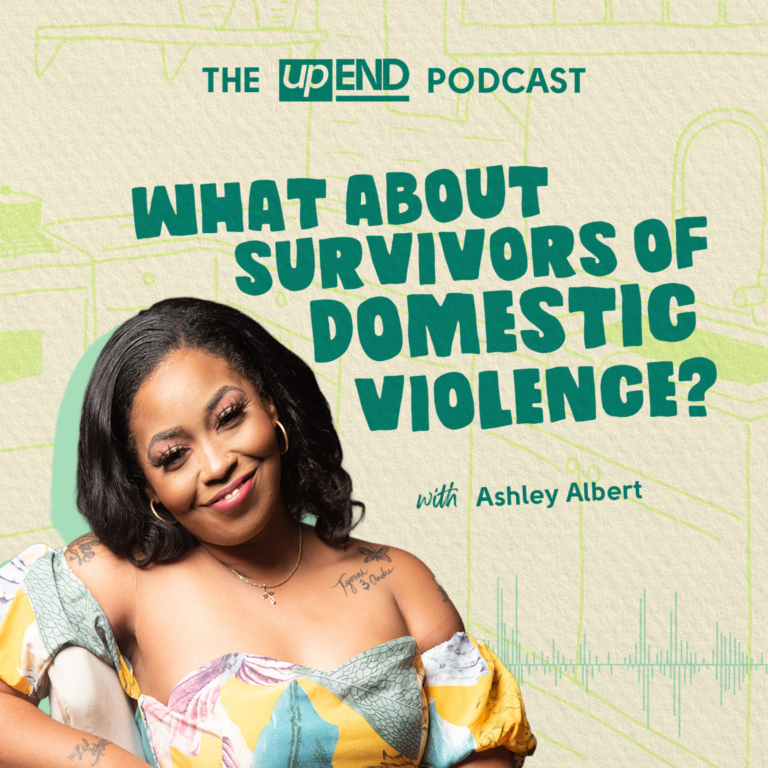
What About Survivors of Domestic Violence? (with Ashley Albert)
Season 3, Episode 5

Episode Description
How can we support survivors of domestic violence and their children without the child welfare system?
State intervention often forces survivors into impossible choices: remain in a harmful situation to keep their children or engage with a legal system that might use their trauma as evidence of an unstable home.
In this episode, we sit down with Ashley De Anna Albert, an abolitionist, writer, and survivor of intimate partner violence whose children were taken by CPS. Ashley has transformed her own pain into powerful advocacy through Stolen Children’s Month and her work leading healing justice circles that remind us no family is disposable.
Together, we talk about how survivors are punished instead of supported, how the family policing system connects to other forms of systemic violence, and what it means to imagine a future where survivors are met with care, resilience, and community, instead of surveillance and separation.
Learn More
Reclaiming Safety is upEND’s exploration of frequently asked questions about family policing abolition. This episode is an accompaniment to the essay Reclaiming Safety for Survivors of Domestic Violence and Their Kids by Ashley Albert, Josie Pickens, and Sydnie Dan’el Mares.
About Our Guest:
Ashley De Anna Albert is an abolitionist working to dismantle the family policing system and its ties to mass incarceration. Through her advocacy, writing, and healing justice circles, she uplifts the voices of parents impacted by child removal and challenges the racialized harms of foster care, adoption, and termination of parental rights. Her work centers on building community-based alternatives rooted in care, resilience, and the belief that no family is disposable.
Episode Notes:
- Support the work of upEND: upendmovement.org/donate
- Read “Reclaiming Safety”: upendmovement.org/safety
- Learn more about the campaign to Repeal CAPTA.
- Read “Owning Your Story, Claiming Your Power” by Ashley Albert.
- Learn more about Stolen Children’s Month, the annual movement in June honoring families separated by family policing and other carceral systems.
- Learn more about Ashley’s work as the founder of Intuned Consulting.
Credits:
- Hosted by Josie Pickens and Jaison Oliver
- Produced by Sydnie Dan’el Mares
- Mixed by Imani Crosby
Transcript
Jaison Oliver
Welcome to The upEND Podcast where we imagine a world beyond family policing. In this episode, we talk about how survivors of intimate partner violence are frequently punished instead of supported and how the family policing system reinforces that harm. Together, we explore what it means to build a future where survivors are met with care, resilience, and community and not surveillance, punishment, or separation.
Joining us is Ashley Albert, whose work centers healing and abolition, and who helps us imagine what true safety and solidarity for survivors can look like.
Josie Pickens
All right, we’re so happy to have you here with us, Ashley De Anna Albert is a national advocate, writer and peer support specialist dedicated to transforming the child welfare system. A mother, survivor of foster care, and formerly incarcerated woman, Ashley draws from her lived experience to fight against family policing and the civil family death penalty.
She’s the founder of Intuned Consulting and the creator of Healing Circles for Parents Impacted by Child Removal, blending restorative justice with community care. Her work includes developing toolkits such as the Black Momma’s Guide to Surviving Family Policing and leading initiatives like Stolen Children’s Month, a national effort to honor families torn apart by the system. Ashley’s testimony, writing, and trainings uplift the voices of parents while challenging systemic racism and injustice. Hey Ashley, welcome.
Ashley Albert
Hey.
Josie Pickens
We’re so happy to have you here. Can’t wait to get this conversation started.
Ashley Albert
Me too.
Jaison Oliver
All right, thank you again for joining us today, Ashley. Let’s start with you introducing yourself and then sharing how your own experiences connect to this topic of intimate partner violence within families that we’re exploring today for the podcast.
Ashley Albert
Thank you. Beautiful day, everyone. I just want to start by wishing everyone a beautiful day and blessings to everyone. I want to start off by just saying that I’m not going to be speaking from theory. I’m talking about survival. Everything that I say comes from my body, my story, my scars. I’ve lived through domestic violence, lived through incarceration, CPS, the pain of losing my children, the loss of a sibling, the loss of a parent. I’m also a Black woman who carries the weight of reproductive justice, not just the right to give birth, but the right to raise the children we birth, in safety and in dignity.
My name is Ashley Albert and I am from Seattle, Washington. Aged out of the foster care system at 18. I came in at nine. I dealt with a lot of emotional disturbances. I was born into grief. Raised by a woman who came from the South. Migrated her way to the Northeast and then she made her way to the Pacific Northwest and brought all of her experiences with her. And I’m so grateful for that. And it’s because of my grandma how I’ve learned to fight for myself. It’s because she’s fought for me since I was a little girl. And she passed that torch to me when I was able to fight for myself.
So that’s who I am. And I’m just so blessed to be alive today because it wasn’t always like that. I didn’t always feel grateful for waking up, but today I’m so grateful to wake up and meet other people that are my fellows and walking shoulder to shoulder with me. And also hearing stories, survival stories of other survivors that have been liberated from oppressed systems that tried to take them out.
So I’m so looking forward to continuing living life and meeting other people that are like me.
Josie Pickens
All right. Well, we’re grateful to have you here, Ashley. You have shared your story with us and we want to continue uplifting your story and the story of survivors. And we want to particularly talk about how the system responds to survivors. How are people treated by the family policing system when they experience violence from a partner or a family member? And what do you think most people misunderstand about that experience?
Ashley Albert
Let me just be frank. When you’re a Black woman, experiencing intimate partner violence, calling for help feels like choosing between two harms. The person hurting you and the system waiting to punish you.
And even saying that just makes this thing in my throat come up. Family policing doesn’t protect survivors, it polices them. It interrogates them, criminalizes their coping. It treats survival strategies as risk factors. And they hide behind the laws like CAPTA, right? Just to justify the surveillance. Acting like mandated reporting is necessary and the causes to intervene, but really, they’re just over-surveilling and over-policing people. I wrote a book for intimate partner violence and family violence, while in the intersections of family policing and what that looks like.
And a lot of survivors that are not BIPOC, like Black, Indigenous, people of color, Black and Brown women, they get supported and their resources are given in a different way.
And I’m not saying this because I’m black and I don’t like white people or something like that. I have white friends who have had me look in with a different perspective and say, “Ashley, look how I’m being treated. And I got, I got drug issues, right? I’m addicted to meth. Look at the resources that I get and look at how I get treated compared to you.” Right.
Like this is very, like very clear and very like obvious and it’s hurtful. I just think about being 15 years old in foster care and pregnant and in domestic violence and how I was told that I needed to get an abortion.
And because I didn’t get an abortion, I was punished for that. My phone privileges in juvenile were taken away. I was sent from Washington state, which is in the Pacific Northwest, close to Canada, across the country at 15, six months pregnant, all the way to Philadelphia, Pennsylvania, to allegedly protect me from my abuser, which is another young person who’s 15 years old too. And the detriment that caused me, just like not explaining information and saying you’re protecting me. But the moment that I don’t agree with what your thought process is of what I should do, you’re saying it’s my choice to do something. But when I don’t do it that way, then you come in and you’re going to show me who’s really in charge, right?
Thinking about that kind of stuff, and how that shaped me, and how that causes fear. I just think about, not just as a parent, intimate partner violence stuff that I had, but as a young person and even dealing with that in my own reunification with my mother, and how that stuff played a part and how there was no facilitation or support. I mean, they gave these services like family preservation, in-home services, therapeutic services, but all of that was to compliment the department.
These were department appointed people, service providers that collected and had their own collateral information that was given to them by the department that wasn’t given by the family. So they come in with these goals and outcomes that the family needs to work towards without even having an unbiased conversation directly with me or my family, or me or this child’s father of mine, who was also system-involved. Not giving us those opportunities to have that and how that shaped our decision making, how that shaped our trust, how that shaped our way of partnering and collaborating with any provider for that means.
Jaison Oliver
What do you think people misunderstand about some of the parts of the experiences that you’ve described here? Whether it’s the services (so-called) that the state’s providing or whether it’s these decisions to send you across the country? Like what do you think people misunderstand about the things that you’ve experienced or you see other people experiencing?
Ashley Albert
I think people misunderstand, and I think that is happening today. Like there’s very awful things that are said about young people. Especially kids who are Black, know, kids who are melanated, kids who come from the African-American community and the things that we have had to endure and what we lack. And then the way that we survive and how we’re penalized for that and punished.
I think that when you hear a child has to get sent across the country… because a lot of our roots come from the South. So when you hear about all these young people having to get sent to the aunt and uncle down in Alabama, or to the grandmother in Florida, or to the father back East, right? Like where a lot of our roots come from, like our roots, our ancestral roots, our history, the things that we don’t get to learn up in the Pacific Northwest.
There is a misunderstanding of why that happens. That wide net of support happening, the system calls that “enabling,” right? Or like families trying to “run away.” Many times my grandmother was told that she was enabling me when she was just trying to help and she didn’t agree with their ways of doing things. And we’re talking about a Black woman who comes from the South, has lived experience in the South who went to school up North in Philadelphia, graduated college, and is an educator around child development. And doing the best that she can with what she knows professionally, spiritually, emotionally, and then what she knows because this is her DNA, right?
Just the misinterpretations of how like Black women are left to do the best they can to deal with children that come from certain demographics like substance use, where their parents were using when they were fetuses. Or children that might be on the autism spectrum. These different things that society doesn’t see as normal, but these families that touch these systems such as family policing or incarceration, all these different systems, and how we’re left to figure it out. And when we figure it out, we’re demonized for that. And penalized for that, and ostracized.
I like to just take a moment just to salute all those single parents. I don’t care if you’re a man, woman, transgender, or whatever pronoun you use, thank you. Thank you for doing the best you can. Thank you for doing the best you can with our kids, and making sure that they don’t wake up every day wanting to escape life. You know what I mean? Like they don’t know what it’s like to raise a Black kid who’s suicidal. They don’t know what that’s like. Sorry.
Josie Pickens
Yeah.
Ashley Albert
They don’t know what it’s like for an ill individual who doesn’t have their own support, have to fight against the system to protect children, whether it be their own child or through kinship care, right?
From having to touch a system that’s going to do some awful things to them and tell them lies and just treat them in a way that isn’t of love and care and support. That’s what our kids need. They don’t understand what that’s like.
So when we have to make these decisions about how far we’ll go to send our kids or having these ultimatums, or these choices of what’s right or wrong or what’s better, or how we’re gonna protect and provide for our family. And I think it just would be a due diligence for all people with implicit biases, even myself, just to understand. To ask questions to understand, not ask questions to penalize and prosecute and report to somebody so that this family, or these people, are worse than when you met them. There’s just more that we can do.
Josie Pickens
We hope you’re enjoying The upEND Podcast. A quick note: upEND is funded through the generosity of people like you who believe that ending the harm of the family policing system will help us to create a safer future. If you’re enjoying this podcast, we hope that you’ll consider donating to our work. Visit upendmovement.org/donate for more information.
Jaison Oliver
I’m hearing, something I’m hearing from you is that people are doing the best that they can and really trying to, make a way out of no way, right? And some of that is choosing to reach out for help, right? Some of that is really just trying to do the best you can with what you have, but a lot of people do try to reach out for help, but they fear losing their children by reaching out. Where’s that fear coming from of people losing their children if they reach out for help? Do you feel like it’s justified based on what you’ve seen in your work?
Ashley Albert
Absolutely. Within even my own work amongst other abolitionists, there’s still biases around when there’s harm done to a child, right? There’s still people trying to figure that out. Is it worth removal? Is it not worth removing? Right?
People are talking about “Community is supposed to keep you safe.” But the community has a different measurement of what safety looks like. And then if that safety doesn’t look safe to them, then who do they call? The police. Who do they call? CPS.
They’re not going to be like, “My name is Ashley Albert, and I want to make a report.” They’re going to make an anonymous report.
And that’s why people don’t want to step up. Cause what are you really going to do with that information? People are always saying things like, “Just tell the truth and be honest. Josie, just come on, be honest. Jaison, be honest.” Right? Like, just be honest.
And it’s like, do you have the capacity and the bandwidth for my honesty, baby? You know what I’m saying? Because see, it ain’t a matter of me being honest. It’s a matter of what are you going to do with my truth? Because I have to protect myself. You know what I mean? And that’s it. And I think that that’s the question people should be asking in regards to when people are not reaching out for help, because to thine own self be true. If I know what I know, what I need or what I don’t need, I could give a damn about what you say. You know what I mean? And the truth is, it doesn’t matter what I say to you. You’re gonna do what you wanna do anyway. If I don’t fit your version of what it’s supposed to look like as far as safety and how I’m taking care of my child, how I’m combing their hair.
It goes all the way into our own homes. We have grandmothers telling mothers how to put the coat on their own baby. You know what I’m saying? It’s just like, it’s just a lot like parentalizing. I don’t think it’s a matter of not wanting help. I think people do want help. They just don’t want to get beat down and talked about and made to feel like shit, and feel shame and guilt while they’re asking for help.
And I think it’s very courageous, I just want to say, for people to step out, because there’s a lot of folks in the work that I do who are dealing with the loss of parents. They’re taking care of their grandparents who raised them while they were in the system themselves, on hospice while losing their children, right?
So when I think about why people aren’t asking for help, I think about everything they think about the risk they take on, what they can lose. We already know what you think and what you’re going to say. No, I don’t always have a cabinet full of food. Trump and them just cut food stamps off. You know what I’m saying? Like we were out of food for a while. Who wants to let people know that they don’t got food in their house? Who wants to let people know that their water is cut off. Who wants to let people know that they have to put on the same dirty clothes two days in a row or three days, or however, because they don’t have the money to even go to the laundromat.
But as a society, we talk about what you should do, and if you can’t do it, ask for help, right? And why don’t you come and ask? And I think it’s a lot of it because we already know what you’re gonna do with that information, and it’s exploit.
Josie Pickens
Yeah. And that’s the thing, right? We’re talking about sometimes even communal responses to harm that happens. And when you’re asking for help, instead of receiving that support and that care, we’re stigmatized. We have to deal with all of these things, even outside of the system, even within community. And that’s something that we absolutely have to address is figuring out how to push away from punishment and surveillance, which we’ve learned through systems, right? This carceral logic that we all have. We have to fire the cops that live within our own brains in order to, as you said, Ashley, be able to really look at people and assess the best ways to help and support and care.
So if we step away from punishment and surveillance in community, what would real communal responses to these harms look like? How can we center the safety and healing of both children and adults in this process when we’re talking about intimate partner violence?
Ashley Albert
Thank you for that question, Josie. I think true safety doesn’t come from the state. It comes from community. And safety is knowing your people. Knowing your people will show up without CPS or police. Safety is the elders, the grandmothers, neighbors, aunties, the corner store clerk, the lady that’s always walking her dog at the same time every morning. Safety is creating a net before you fall. And it’s also accountability that doesn’t require losing your child to get support.
Community care is how Black families have survived for generations before the state stepped in and called it “neglect.” And I remember with my grandmother, her being able to call on her siblings. The great aunties and uncles, the teachers that took a special interest in me, the certain people in the community that saw grandma having us, and they became my community. Like that was my life. That’s what I remember from my childhood. Community is the safety, the supports, those grassroots movements, right? That rise up in wake of whatever is happening in that moment for that generation.
And I remember like for mine, it was the Union Gospel Mission Youth Outreach Center. It was a Christian-based, Bible-based facility. But a lot of the kids that I went with, there were kids who came from the projects and stuff, came from the hood, kids who were unruly.
Jaison Oliver
That’s one way of putting it.
Ashley Albert
Yeah, the kids who went to juvenile. I mean, we was raised by our grandmas. We was raised by our aunties. I mean, we had college interns that came from colleges and stuff and they worked with the youth. We had basketball teams. We had a boxing gym inside of there.
They fed us a snack after school. They picked us up from school in vans. To register for a whole year where a child can get picked up from school, and you could stay for the after school programs and the vans will take you home too. They feed you dinner. You’d do your homework and then you’d do the extracurricular activities, all while your parent is still working in your out of school for $5 a year, right?
So when you talk about making things accessible, making things equitable, it didn’t matter if you worked at Boeing or if you had food stamps. This was a place for everybody.
And let me tell you, every Black and brown kid, I don’t care if you spoke Swahili, or whatever, like, I don’t want to disrespect nobody, but if you spoke multiple different languages, we was all kicking it up in there. Because we all looked alike and we all shared a commonality, and we all shared an understanding of one another. So like a lot of us had anger, right? A lot of us had IEPs, or if it wasn’t us, we had a sibling, right? We were a community of kids who understood what it meant, what it felt like, and what it looked like just to survive. And so that’s where we built our cousins, our play sisters, our play moms and aunties and stuff. Until this day, when we see each other, we still call each other family. And it’s not like we’re blood family, but we are family.
Josie Pickens
Yeah. Chosen family.
Ashley Albert
Yeah, this is like a chosen family, a community. And where now we are doing the work in the community to restore and preserve families, particularly Black families, because we know what it was like, right? So community care is how Black families definitely survived for generations before the state stepped in and called it neglect. When we build networks like the one I was just saying, that’s definitely rooted in compassion instead of compliance. We are not just protecting survivors, we’re protecting the whole community from state violence.
And what that ends up being is, like we end up teaching kids, and kids can partner with parents and community partners where now we’re doing like fundraisers and events where we’re going out of the state to go to Hawaii, and we’re taking leadership trips, and we’re junior mentors, and we’re grooming and priming and pruning these kids to become the best that they can, right? And all of that takes a whole entire community. You know what I mean? So when you ask that question, that’s what comes to mind. Thank you for asking me.
Josie Pickens
And you covered so much.
Ashley Albert
Thank you for asking me that because I talk a lot about the harm and stuff and a lot of the darkness of my childhood. But I also have to say and I can’t not mention that what people love about me, or what they have found to like about me, especially in like my presence and my spirit, didn’t just come in the recent years. This has always been a part of me.
And I have to say that my grandmother made sure that she kept loving, caring people around me.
Jaison Oliver
Yeah to foster that in you, to foster that light, yeah.
Ashley Albert
Because I had that state violence. But I also had this community who was telling me… Ashley Albert was on the rise, she was on the horizon. So I’m just grateful for kinds of things.
Josie Pickens
Yeah, and you mentioned so much when we’re talking about what community care looks like in the program that you discussed. You’re like, there’s food being provided. There is support and transportation, transporting kids to and from school. There are after school activities and enrichment so parents can work. It’s like, this is what we understand survivors need, or parents need, and children need.
And that does absolutely help keep families out of the system when those supports are rooted and grounded in community. And as you said, when that support is provided out of care and that this whole compliance and coercion that we see within the family policing system. So thank you for that example and for letting us into a little bit of Little Ashley’s life there.
Jaison Oliver
Yeah, I want to shift a little bit. You’re making me think about some of my own experiences as a kid, coming up in after school programs. There was a program called Seed Academy that I talk about with fondness. I remember the director of the program Ms. Smaller, we’d like spend a lot of time at her house. It was an amazing community of young people and adults to just be around, and it was really enriching.
We also have, on the opposite end of these nurturing spaces, we also have cultural messages that move us more toward the shame and stigma that really lead to people being silenced, right? How do these cultural messages, especially those that tell Black women not to involve the system for fear of further criminalizing their partners or Black men they love, how do these cultural messages shape the ways survivors seek or avoid help?
Ashley Albert
There’s this unspoken rule in the Black community: protect him even if it costs you.
I think that it happens without even folks knowing that they’re doing it. I just think about my own experience and the things that I watched, whether it was on TV, or the stuff my mom went through, or the things that I watched other people go through, like even my own friends.
Black women are taught to keep going and don’t speak on it, carry it quietly.
The abuse, the trauma, the fear, because…
I know for me it’s like, you shouldn’t have been with him anyway. Speak on it like, you’re too beautiful for that. You’re smarter than that. How did you end up with someone like that? I think we don’t want to tell our business, so we don’t speak on that. And we’re looked at as being strong.
Even if we did mention it to someone at work or a friend or something, we’re so good at covering it. I don’t know if that comes from some ancestral shit from slavery or what. Just taking a hit and keep your ass going. You know I’m saying? Keep the kids fed. He gonna calm down.
But like, there’s this thing, where…I know for me, I had, and I think I still do have, a little bit of shame and guilt, from the intimate partner stuff that I have endured. Shame for being able to move forward. Not so much shame, but the guilt of being able to move on with my life, and they can’t.
We all grew up together. And so, it wasn’t like, this man who’s hitting on me or this man who’s trying to hurt me. It was like, this is my childhood friend. Like that’s JJ, you know? That’s JJ who I knew since he had his favorite little red truck. We liked each other, and we been throwing sand at each other’s face and now we’re throwing fists, and we had a baby.
So just thinking about the Black men that are caught up in that stuff too. How they’re portrayed, how they’re demonized as like these violent, scary people.
I’m sorry, Jaison, so much is going through my mind. You could kind of, like, help me out here. I could kind of get a little lost in my thoughts. My son’s dad, who’s in prison right now, came into my mind, and I just kind of went into a whole nother place, so I apologize about that.
Jaison Oliver
No, no, you’re fine. You’re fine. I think we’re really trying to think about what are the kind of cultural messages that we need to push back on or reshape or reframe as we want to help ensure that survivors are able to seek help.
Ashley Albert
As it relates to intimate partner violence?
Jaison Oliver
Yeah, exactly. Yes.
Ashley Albert
That there’s two victims.
Everybody’s a victim or survivor. The person causing harm and the person that is harming at that moment, in some way or another. I don’t think people wake up one day and just want to be a terrorist, like terrorize somebody that they allegedly love or sleep with every night. And I think that that must be extremely hard to have emotions that dysregulated, untreated trauma, displaced anger. And having that kind of stuff and not knowing where to take it. Right. And like it goes back to that question previously about asking for help, and feeling safe enough to ask for help and support. Both people are dealing with harm.
And the work that I’ve been doing around domestic violence, too… A lot of times, I don’t know the percentage rate, but a lot of times, it looks like the male partner is most of the time the violent one. And so a lot of times, the perpetrator, I don’t know the right language and please correct me because I don’t want to be offensive. But the perpetrator is more, looked at as the harmful one, when there’s not even time or an assessment taken to see if that person had been a victim of abuse themselves.
And I will say this, I have been that person. I have been that person. I literally have been that person. I have been angry. There’s no way in hell that I could sit up here and tell you guys that I’ve been through all this fucking violent shit, and I wasn’t an abuser or perpetrator or whatever. Whether my kids felt like that emotionally, whether my partner felt like that, my mother, my grandma. I’ve been that way, right? And so it’s like, what that looks like and what that means is that we need help. That’s why we be screaming out for healing circles. We need help.
We need somebody that’s willing to come into our families and say, “We need to sit down and talk about this.” Someone that can curate and nurture the entire family without saying who’s more important than the other one. I love the kids and thank God for the kids and everything, but like I’m a spiritual person and where I come from and how I was taught…
Like I’m not even going to do that. But there’s, there’s an order of things, right? Like, and there’s an order in the family, and there’s a structure. And we’re going with that or we don’t know what that should be. We don’t even have the time with our families to sit down and create that, then we’re kind of like an unswaddled baby, an unswaddled newborn. We’re unhinged and we’re going to like have these emotions and these disruptions, and no courtesy, no compassion, no decorum. It’s not safe. So people in their own family don’t feel like they can even speak up without someone speaking over them.
A lot of times we need that support just to be taught that. Or just to be showed a different way of things without being punished or saying that “Your family’s fucked up, and you don’t even need to be together.” That is not what we need to hear. You know what I mean? I’m sorry, Jaison. That’s not what my family wanted to hear. We know we might be a little fucked up and we might have a little stuff going on, but let something happen to one of us. We’re pulling the fuck up. You know what I’m saying? And we’re pulling up deep.
Jaison Oliver
What I’m hearing you say is that these distinctions, it ain’t just a victim, an abuser. Iit ain’t just one side or the other, right? There’s a quote by…I think Danielle Serred who says no one enters violence for the first time having committed it. So really wanting to take into account the things that people are experiencing and healing for everybody.
There’s a gentleman who passed away not too long ago here in Houston, Reverend Gilmore. He’s like, everybody needs therapy. They need therapy. And that would be literally he said that in every single meeting. They need therapy. Yeah.
Ashley Albert
And I just want to say, Jaison, just before I forget my thought, but it’s like… Meanwhile, the system is already on Black men the moment they’re born, and it’s on Black women the moment that we give birth.
Reproductive justice means we should be allowed to protect ourselves and our children and our community, without sacrificing our own lives for silence. You know what I’m saying? Like seriously, and the truth is, that Black men and Black women both deserve safety without punishment. And they’re trying to turn us in against each other. These no contact orders and shit.
If you want to get…TANF benefits, temporary assistance for needy families, you can’t have a man in the home. Then they want to charge the man child support. You can’t get housing if you need housing. You gotta be a single woman, parenting kids. You can’t have a man in the home. If they find out that you’re gonna lose your housing. Like all these tactics and ways of like keeping us divided is sick as fuck.
You know what I’m saying? And we’re tired of that shit. And then you want to sit up here and criminalize us and demonize us because we’re going to utilize your resources, your housing, your TANF. We are going to fucking utilize it. We’re going to utilize that shit and we’re going to keep our fucking families together and you’re going to fucking arrest us and criminalize us for that? That’s fucking sick. Sorry.
Jaison Oliver
Don’t apologize for speaking the truth.
Josie Pickens
That’s it. That’s it. Listen, that’s why we asked you to be here because we know that you’re going to give us the real. So we appreciate it.
And as we’re talking about cycles, cycles of harm, cycles of abuse, cultural norms, we understand that, so many things that we face have a history, including these systems that we face, right? We know that the family policing system didn’t just appear out of nowhere. We know that its roots are tied to settler-colonialism, racism, and anti-Blackness.
How do you see that history showing up today? I mean, you’ve talked about it from a cultural and communal perspective, but when we’re talking about this system, how does that history show up today, particularly in the way Black women and parents are still portrayed as deviant or negligent or harmful?
Ashley Albert
Thank you, Josie. Thank you for mentioning that. Family policing didn’t start with CPS, it started with slavery. And when I say that to people, they’re like “What?” It did. Yeah, come here, come in. Come over here where the grass is a little bit greener, let me show you a little something.
And so I get to show that it started with Black children being sold off, and Black mothers were labeled unfit simply for being Black.
From slavery to the prison industrial complex, where the majority of the Black men are. That’s how they separated the Black men and women. They put the Black men in jail, and once the Black man is gone, they take the child from the mom and the adoption. It’s the auction block, right?
Like it’s very similar and it all ties together, it’s like modern day slavery. It continues through Jim Crow welfare policing, the war on drugs, and now through the child welfare system. Laws like the CAPTA law and the Adoption and Safe Families Act.
The Adoption of Safe Families Act is a 1997 federal law that puts timelines on parents and getting their children. That permanency that they want on kids.
They have this mandated reporting law that says that if you suspect any type of neglect or abuse, you call us and you don’t even have to give us your name. It could be anonymous. And so there’s the anonymous report made.
And then this family who’s impoverished, and it ain’t even nothing that can’t be rectified or reversed, are reported. And now they’re in a system that puts a timeline on them that says you have 15 to 22 months. That’s the Adoption and Safe Families law that I mentioned. It puts that timeline that says you have 15 to 22 months to do everything that the Department of Children, Youth and Families is telling you to do to get your children back. All while at the same time as they’re telling you that you have 15 to 22 months to get your kids back, they’re working to move to adopt your child, right? So they’re tracking two different things at the same time.
If you don’t meet that time line, if you don’t repair and get over that grief or the loss of your father that led you to use those substances, if you don’t get through that in 15 to 22 months, you’re gonna lose your rights to your kids forever. That’s some awful shit. And we call that the family death penalty.
They rebranded, but they are saying that Black families are the problem, Black families are hard to manage, Black children are hard to manage, and Black women that are in single parent homes don’t know how to raise their kids. And these are the ones that they target, and those are the stereotypes.
I don’t know if you all saw what was happening on social media when the majority of those kids were Black. Those are our kids that come from our community that attacked that pregnant woman and her son in Chicago, right? And people are talking about “Them kids need to go to jail. They need to get through this and they need to do that.” And it’s just like, damn, that’s that same shit that we’re talking about that we’re trying to undo.
How do we ask mercy on me, but justice on you? Trying to really unfold and unlearn how we even got here. That’s community saying, “Hey, call the police, send them to jail.” But that same community is the same one screaming Black Lives Matter and defund the police. But the moment that something happens to you, you’ll step into that act of working with the same system that we’re trying to unravel.
So I just think that there’s a lot of stereotypes about just Black moms, about us being angry, unfit and neglectful, and poor. Being too strong and not soft enough. How these other women that come from these other cultures, how they’re easier to deal with, easier to get along with, how they serve their men, how they comply, and they’re complicit if you ask me.
But that’s just the same messaging that the enslavers used. Nothing about this system is new. It’s a continuum.
Jaison Oliver
You talked a bit about the trauma of separation that stays with families even after some sort of reunification has happened. But I want you to share more about what real repair or reparations might look like for families who have survivors of a family separation.
Ashley Albert
I think people think reunification is the end of the story. [Laughs] Lord have mercy. Seriously, Lord have mercy.
Because for a lot of us, reunification is the beginning of another battle. Learning how to trust again, how to parent after being monitored, how to bond with children who were separated from us, how to heal wounds the system refuses to acknowledge. We need more. A signed proclamation from a governor for reunification month stating that you did everything you did to get your kids back, that’s not enough and it’s not the end of the story.
When I think about reparations and repair and all that, first of all, I think we all deserve repair, not apologies. Not reforms, but real reparations from the harm the system caused. Because healing without repair is just survival dressed up as resilience. A lot of us parents, even youth that have been involved in this system, we’re tired of that word “resilience”. It’s bullshit. You know what I’m saying? It’s bullshit because nobody asks to be resilient. We didn’t have a choice.
So when I think about reparations, first of all, I think about money, right? Money for the emotional harm caused. Cause a lot of us, we were picked on for being poor. We were picked on for not having certain things that other people had. Had we had some money, we would have said, “We ain’t talking to no CPS. Call our lawyer.” And a lot of people with money don’t talk to CPS, they call their lawyer. You know what I mean? So when I think about reparations, I think about money. Absolutely.
I also think about things that I’ve created such as healing circles. Because like I said, that’s not the end of the story, the reunification part. People have been separated from their children and under the guide of other adults, whatever that might look like, their structures, their rules, their policies, their norms, their spiritual beliefs. Like they’ve entered into that. Like that’s hella exhausting. And I think that’s unfair to put people back together just because they’re related, without having genuine care and interest and like a slow walk back into the relationship.
What is that called? A shotgun wedding? When you just meet somebody and then you get married real quick?
Jaison Oliver
Well, that’s when you get forced to. A shotgun wedding is when somebody’s dad or something forces you to get married, cause it’ll look bad for y’all to have been dating or having a child or something like that. So they force you to get married.
Ashley Albert
Well guess what, Jaison? Guess what, Jaison? There’s shotgun reunifications.
People, you have a timeline. You have substance use, clinical people, trauma people, medical people saying that healing has no timeline. But then you have a system that gives you a timeline on what you’re supposed to rectify what brought you into the system. Drugs is not the issue, it is a symptom. Something else is going on and it takes time to uncover. It takes time for people to even say that they even want help. You know what I’m saying? Because really it’s not about the child. The child ain’t being abused or neglected or nothing. The parent needs help and the parent is somebody who needs the support. But yet. We use the baby. The kid is a casualty of war between a system and a parent. Where “If you don’t do this and get this, I’m taking your kid and you’ll never get him.” What the fuck?
Jaison Oliver
Take them now or else you ain’t never getting them.
Ashley Albert
What the fuck? Do you know where I come from? Don’t fucking tempt me. Don’t try to fucking bully me. See, now you want to fight. You know what I’m saying? It’s like, when you start talking like that, you start waking shit up in people that wasn’t woke before. And when you start using language and tactics and strategies that are not conducive to a certain demographic of people, or even people in general, you’re causing a collision.
So when I think about the repair part, we definitely need the healing circles and stuff. Who needs to be at the healing circle? The state, their ass definitely needs to be there. I don’t care if it’s a social worker. I don’t care if it’s a director. I don’t care. Everybody had a part in the situation and everybody got it. Like there has to be some repair and some reconciliation because there were things said and done in people’s cases.
And I’m not the only one who feels this way, that what was done should have been handled differently. And the reason why they were done, Jaison, is because there was implicit bias. Why was it implicit bias? Because they thought some way about me, because I was a Black girl who had a baby at 15, who came out of the foster care system, whose grandmother raised me. I wasn’t married. I didn’t have an education. I had an IEP. I had my own childhood trauma stuff. And they moved and handled me in ways that made it more harmful for me and my children, even when reunification was in the best interest.
So we definitely need healing circles. People need to be trained up on transformative justice, restorative justice. Whatever they’re working off of, and I’m talking about the system, they need to scrap that shit. And they need to just go ahead and pay attention to what we are offering, right? Because there’s still an offering. We’re just not letting you drive the car no more. It’s over. You know what I’m saying?
And we’re not trying to forget about the kids who are being harmed. We’re just trying to not put kids in the system who don’t need to be there. Because the system is an easy place for sickos to target and get their hands on kids. And while they sit up there and talk about parents harming their kids, there’re people that work within the system that cause more harm. And we don’t hear about that. So that’s why we need reconciliation. When you talk about repair and all that, we need those spaces because it ain’t just no one side causing harm, right?
Social workers might be scared to send kids back home to their parents for whatever reason. And guess what? We’re scared to have our kids go to foster care in someone else’s home too for the same exact thing. Why are we not having these conversations? Like why are we singling people out? And as a matter of fact, they’re doing Black women the worst.
Josie Pickens
You’re just offering us so much, Every sentence reminds us of why we wanted you to be here on this episode. You’ve offered us so much truth today. And I want to personally thank you for being the change because in all of the ways that you’ve talked about how harmful this system is and all of the harm that you’ve experienced, I know that you’re also doing so much work to create new possibilities and create new ways for survivors and families.
And before we go, we wanna share a bit more about your work, including Stolen Children’s Month. Let’s talk about Stolen Children’s Month and also how listeners can connect with you and support the work that you’re doing. But yes, let’s begin with Stolen Children’s Month, which is part of the answer to all of the things that we’ve discussed today, all of the harms that the system perpetuates against survivors and families.
Ashley Albert
Oh my God, I’m going to cry because like, I am just like, I’m still in awe. So first, before I even get into that, a way for people to contact me, and I would love for you to contact me. I would love for you to partner with me. You can email me at Ashley at Intuned Consulting dot com. That’s Ashley at Intuned Consulting dot com.
Okay, so thank you for that. Everything that I do and have been doing from Stolen Children’s Month to my healing circles, they all come from a place of pain.I just refused to let the stuff that happened to me destroy me. Turning my story into a strategy. Turning my grief into organizing. Like this is just wild. I turned my lived experience into a blueprint for other parents. Stolen Children’s Month is about to happen again in June, 2026.
I created that. The first moment that it was an idea happened was in Houston, Texas. When a few of us met with upEND to discuss different ways of how we’re going to abolish family policing. We met in October of 2024 and I was sitting in there with all these like brilliant, amazing people. We had just had this amazing convening with these great speakers who were talking about organizing and they gave us strategies on like how to organize and what that looks like for different folks and wherever you are in your organizing for the movement. And I just got really inspired.
And at the same time I was dealing with my kids coming back from an adoption that failed. And so I was really emotional. Adoption Awareness Month was happening the very next month in November, which happens every year. And I was tired of that. I was like, why are we celebrating like reunification month in June and adoption month in November?
Like people getting these kids and stuff. And what about the parents that didn’t get their kids? And I really wanted an answer to that. Cause I wondered if other people felt the same way. And I was like, we don’t get nothing. And I don’t know who, it just started to popcorn. And someone was like, “Well, we could do a day.” And then someone else was like, “F a day, we’re going to do a month.” And then it was like, well, which month are we going to do? And then it just started populating all over the room. My eyes just start going like this and I was like, “Shit. What did I start?” And people just start looking to me and they’re like “Ashley. Yeah, we’re gonna do this. This is a great idea. Like yes. Yes.” I was just like whoa, right?
Well October 24 turned into January of 2025 and in between those months there was some silence. Who was silent? Me. Why was I silent? [Laughs] I was silent because, shit, I thought that I put the idea out there, and somebody else was going to pick it up and run with it. I guess that is a part of how I have been used in other areas in the work that I come from, where people have taken credit for things that I created. So I think that I surrendered it before I even could even think that I could have the vision and manifest it.
But January came and I entered into a fellowship with Movement for Family Power. And they were talking about supporting folks with their community projects, their campaigns and things. And I was like, I just want to be a better public speaker and create trainings and all of that. So I was talking about the wrong shit. So Jasmine Sankofa, shout out to Jas, did a one-on-one with me and was like, “Hey, sis, what happened to the Stolen Children’s Month?”
And I was like, “Huh? I thought somebody else was going to do that.”
She was like, “Girl.” She started cracking up and was like, “No.” I mean, she was belly laughing. She was like, “Ashley, heck no, this is your baby. You said it. We’ve been waiting on you.” And I’m like…
Jaison Oliver
You need those people in your ear to remind you like this is yours. Yeah.
Ashley Albert
Yes, yes, Jaison. And I was like, oh shit, I’m late. Because we said Stolen Children’s Month was going to be in June. Now it’s about to be February, right? Okay, boom, I have to hit the ground running. But little did people know, I’m a writer, I’m a visionary. So I’m always like creating and having stuff already kind of like prepared, like thinking and just putting things out there and I had a lot of notes and I had a lot of ideas.
And guess what else I had? Relationships. So there it was, I started to form a committee and I said, I’m gonna get the hottest committee out there. So I asked a couple of people from upEND I asked some people from MFP, I got some people from Operation Stop CPS, the Black Mother’s March, a couple of different parents and folks who lived experience. And I just asked if they would come alongside me and they said yes.
And there, that’s where it began and we met. I know that I went full force because people were like, “Ash, if you just want to do a couple different things, that’ll be okay. You accomplished a lot.” But inside of me, my spirit said, “Hell no.” Seriously, my spirit said, “We’re not doing a couple of nothing. We’re doing all of this.” And I had to continue. I mean, I prayed and I prayed like during this time I was close to my power. I had given up a lot of different things, a lot of different things for myself. I self-sacrificed a lot of things. So that I can be open and let a spirit come inside of me, so I can do things beyond my wildest dreams.
And I’m telling you, beyond my wildest dreams, Stolen Children’s Month took off in June. We hit every milestone, we hit everything that we said we was going to do. We hit that thing. We had it jam rocking, right? We went from a national campaign to a global campaign. Till even after June finished, I got parents hitting me up right now talking about when’s the 2026 Stolen Children’s Month Toolkit going to be out? When this meeting is going to happen? People are ready, they’re on fire. This is what they needed. This is what we needed.
We needed a space that honored parents who didn’t get their children back, but honored parents who are still in the fight, right? Because just because you didn’t get your kids back, that didn’t make you unuseful. That didn’t make you like a throwaway. I know people who didn’t get their kids back and are doing amazing things, and that wasn’t talked about. So we got to do healing circles, offer love letter writing, love letters for children who are still separated from their parents.
And we did visuals. We did visuals across the world on the same day. And we even have vigils where parents, everybody came and we had food and we just stood around with pictures and stuff and we grieved publicly. And it was beautiful.
And we also acknowledged the truth about family policing. And we talked about the mental health impacts on parents and youth, right? We just did a plethora of offerings. It was so full that there was no way you could have left hungry. You might not have been full to where your stomach was about to bust open, but you got a little bit of something. And that was more than enough for me. And what’s happening now is that Stolen Children’s Month is still alive. Healing Circles are still alive. I just got connected to a fiscal sponsor that wants to be the fiscal sponsor from Stolen Children’s Month. So I’m getting ready to sign a contract for that, right? I got a grant writer who’s going to help get the funding for Stolen Children’s Month.
I also have been in conversation with the folks here in Washington state where I wrote a resolution based off of Stolen Children’s Month. And it was passed at the local level, twenty-nine to two vote. It’s now at the Central Democratic Committee of Washington State. They meet in January. I have folks at that local level, the politicians really wanting to support Stolen Children’s Month. It was their idea to even have it get written into a resolution so they could get it passed into a bill. And I think that that is part of the reparations, because I really wanted to tell them, and not probably, I still will, tell the Democrats that it was their colleague, was their fellow that passed the ASFA bill in 1997, and it would be a due diligence and an honor for your own party to show my people, my community that you’re ready to move forward and take accountability for the harms that was caused.
So when you support the resolution, Stolen Children’s Month has the healing, so everything that we created and provided in June, the offerings are in the resolution for Stolen Children’s Month. Getting educated, right? Getting trained up on transformative justice and healing justice and restorative justice. Funding healing circles. Letting folks that are directly impacted lead the spaces and for politicians to encourage their colleagues to get trained up and learn more and invite us to meetings so that we can continue this discussion. I am just so pleased and I am proud to be a servant of God to do this work and to carry the message of hope. That’s what it is, is a message of hope.
They took our kids and left us hopeless. They took our parental rights and said that we were nobodies. There was nothing left for us. They told us that our kids would be better off without us. Stolen Children’s Month says the opposite and it invites everyone, whoever you are, to start repairing and reconciling the harm so that we can move forward because the kids and these next generations that are coming up deserve it.
And we all know that children have a story. We had a story when we was kids and we told our story. So I just want to remind people which side of history do you want to be on? Do you want to be on the right side or the wrong side? But just know your ass is going to be in history and just pick a side, baby.
Josie Pickens
Ooh. We had a question around abolitionist perspectives, but we recognize Ashley that everything that you offer brings us into abolitionist futures. You’re living abolition now. We are so grateful for you and your work and your vision and your fight and you sharing your powerful story over and over again. So, yeah, I’m in awe. I don’t have anything else to say, but thank you, thank you, thank you for being with us today. We really appreciate it.
Jaison Oliver
Thank you, Ashley.
Ashley Albert
Can I say one more thing? I just want to leave the listeners with this, that healing becomes possible when control isn’t the first response.
Josie Pickens
Yes.
Jaison Oliver
One more time, one more time.
Ashley Albert
Healing becomes possible when control isn’t the first response. Healing becomes possible when control isn’t the first response, and hope becomes real when care is the default.
Josie Pickens
And that’s abolition.
Ashley Albert
Just like that.
Josie Pickens
Just like that. Thank you, Ashley.
Ashley Albert
Thank you.