
← The upEND Podcast
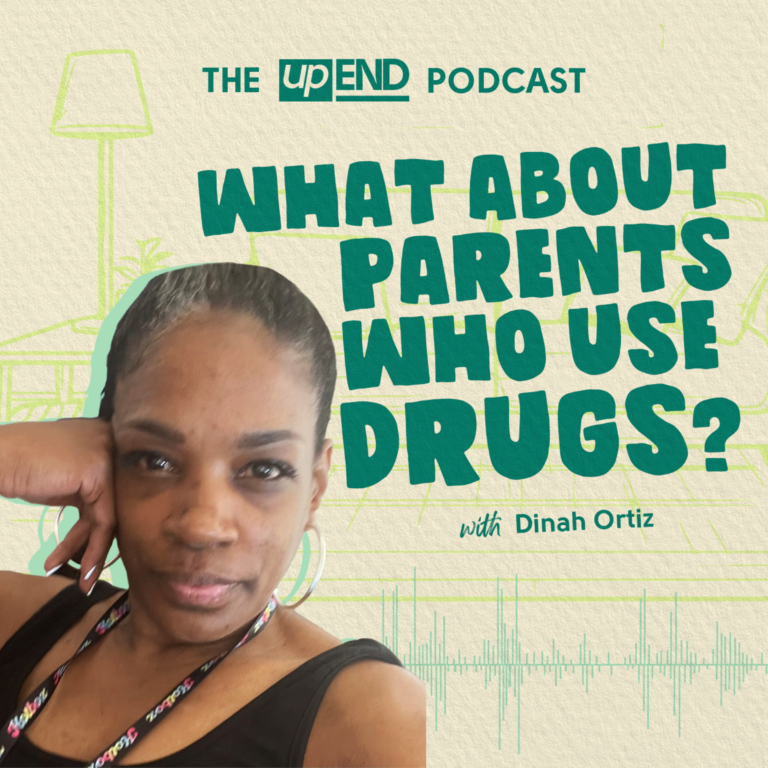
What About Parents Who Use Drugs? (with Dinah Ortiz)
Season 3, Episode 4

We can build a society where children and families are strengthened and supported, not surveilled and separated. The upEND Podcast illustrates that the “child welfare” system is beyond reform and needs to be abolished. The only solution to ending the harm of what we name the family policing system is a fundamental reimagining of the way society cares for children and families.
“Parents who use drugs, we're at the bottom of the totem pole.”
We explore what real safety looks like for families when a parent uses substances. Stigma, shame, and anti-Blackness shape the way families are treated by the family policing system, but community centered care can save lives and families.
Together, we imagine a world where families impacted by substance use are met with compassion, resources, and community support rather than punishment and surveillance.
About Our Guest:
Dinah Ortiz has been working on behalf of people who use drugs and pregnant and parenting people for over two decades. She has spent much of that time at a Well renowned holistic public defense organization as a parent advocate, supervisor, trainer for incoming Attorneys pre bar, Social workers and as an internal thought leader on harm reduction. She serves as a board member for the North Carolina Survivors Union (NCSU) and is a current member of the leadership team for the National Survivors’ Union (NSU). She has sat on advisory boards for work supporting federal rural overdose response grantees, and currently for the Albert Einstein College of Medicine IMPOWR-me project as a board member. Coming out of direct parent representation for over a decade Dinah slowly came to understand there was something missing in the representation of marginalized parents who use drugs (our voice.) She has appeared on hundreds of panels globally sharing the challenges created by the child regulation system and its disproportionate targeting of marginalized communities and communities of color. She helped adapt and develop a storytelling model for people who use drugs—helping people work through their own experiences so there is space for reflection where stigma has been internalized, as well as equipping people to share their stories to disrupt larger narratives.
Episode Notes:
Support the work of upEND: upendmovement.org/donate
Episode Transcript: upendmovement.org/podcast/episode304/
Read “Reclaiming Safety for Children Whose Parents Use Substances” by Kassandra Frederique, Dinah Ortiz, and Mark Z.
Dinah mentions a segment about moms using marijuana on the Tyra Banks show.
Learn more about the North Carolina Survivor’s Union and the National Survivor’s Union.
Dinah mentions Movement for Family Power’s Movement Map.
Episode Description
“Parents who use drugs, we’re at the bottom of the totem pole.”
We explore what real safety looks like for families when a parent uses substances. Stigma, shame, and anti-Blackness shape the way families are treated by the family policing system, but community centered care can save lives and families.
Together, we imagine a world where families impacted by substance use are met with compassion, resources, and community support rather than punishment and surveillance.
Learn More
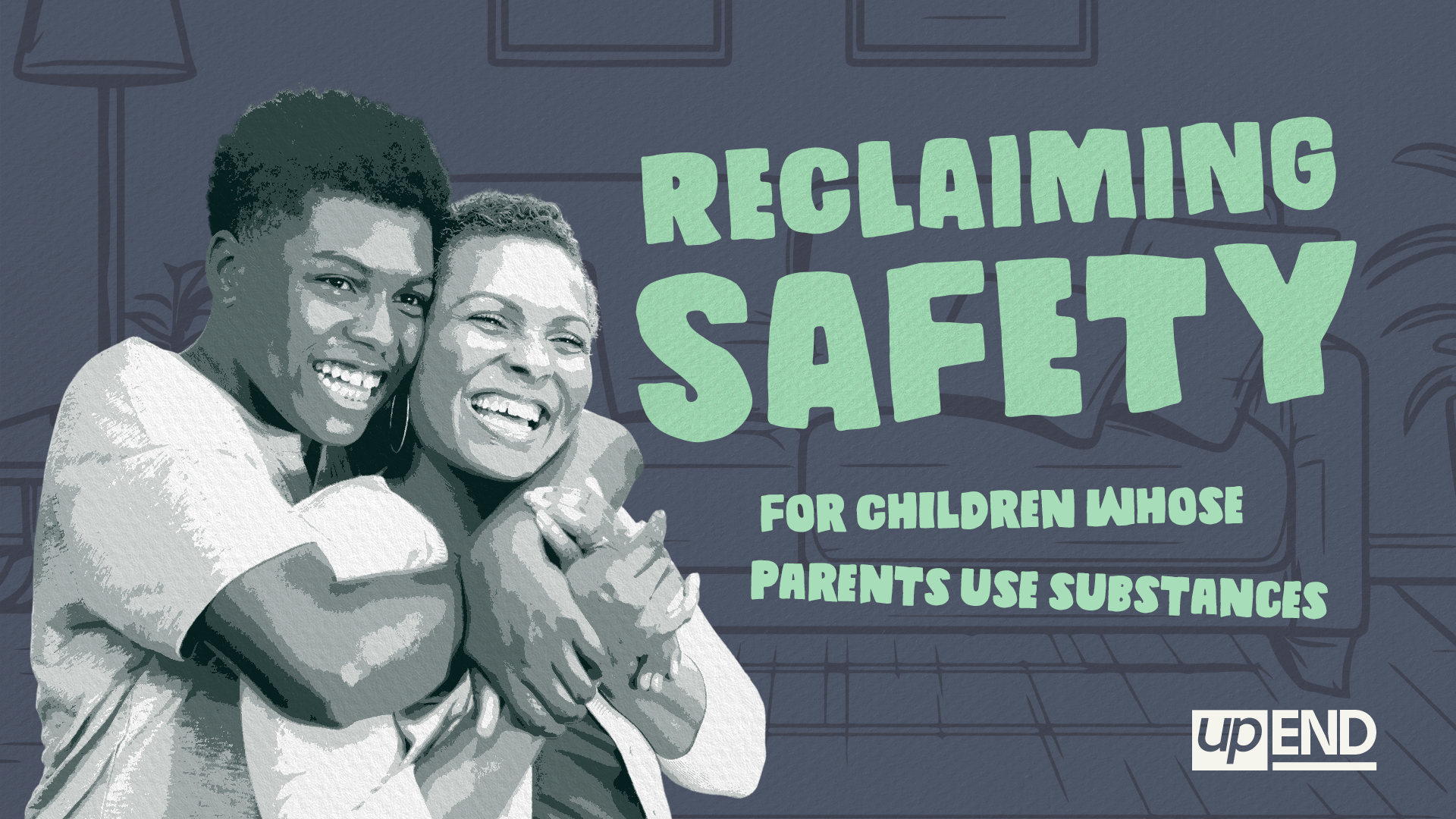
Reclaiming Safety is upEND’s exploration of frequently asked questions about family policing abolition. This episode is an accompaniment to the essay Reclaiming Safety for Children Whose Parents Use Substances by Kassandra Frederique, Dinah Ortiz, and Mark Z.
About Our Guest:
Dinah Ortiz has been working on behalf of people who use drugs and pregnant and parenting people for over two decades. She has spent much of that time at a Well renowned holistic public defense organization as a parent advocate, supervisor, trainer for incoming Attorneys pre bar, Social workers and as an internal thought leader on harm reduction. She serves as a board member for the North Carolina Survivors Union (NCSU) and is a current member of the leadership team for the National Survivors’ Union (NSU). She has sat on advisory boards for work supporting federal rural overdose response grantees, and currently for the Albert Einstein College of Medicine IMPOWR-me project as a board member. Coming out of direct parent representation for over a decade Dinah slowly came to understand there was something missing in the representation of marginalized parents who use drugs (our voice.) She has appeared on hundreds of panels globally sharing the challenges created by the child regulation system and its disproportionate targeting of marginalized communities and communities of color. She helped adapt and develop a storytelling model for people who use drugs—helping people work through their own experiences so there is space for reflection where stigma has been internalized, as well as equipping people to share their stories to disrupt larger narratives.
Episode Notes:
- Support the work of upEND: upendmovement.org/donate
- Read “Reclaiming Safety for Children Whose Parents Use Substances” by Kassandra Frederique, Dinah Ortiz, and Mark Z.
- Dinah mentions a segment about moms using marijuana on the Tyra Banks show.
- Learn more about the North Carolina Survivor’s Union and the National Survivor’s Union.
- Dinah mentions Movement for Family Power’s Movement Map.
Credits:
- Hosted by Josie Pickens and Jaison Oliver
- Produced by Sydnie Dan’el Mares
- Mixed by Imani Crosby
Transcript
Josie Pickens
Welcome back to The upEND Podcast where we imagine a world beyond family policing. This episode is a companion to our reclaiming safety series where we explore what real protection looks like when we move away from punishment into our care. Today, we’re talking about what it truly means to create safety for families when a parent uses substances. We’ll look at how the family policing system acts as an extension of the drug war, punishing rather than supporting, and how stigma, shame, and surveillance leave little room for compassion. Together, we’ll imagine what abolition-centered support can look like in practice, communities that offer help without judgment, safety plans that don’t rely on state control, and networks of care that meet families where they are with understanding, material support, and love.
Jaison Oliver
Today we’re joined by Dinah Ortiz, who has spent more than two decades advocating for people who use drugs, including pregnant and parenting people. Much of her work has been with a nationally renowned holistic public defense organization, where she served as a parent advocate, supervisor, and trainer for incoming attorneys and social workers, while also leading internal conversations on harm reduction and family support.
Dinah serves on the board of the North Carolina Survivors Union and is part of the leadership team for the National Survivors Union. She has also advised projects supporting rural overdose response and currently sits on the board for the Albert Einstein College of Medicine’s Empower Me Project. After more than a decade of direct parent representation.
Dinah realized there was something deeply missing in how systems support marginalized parents who use drugs. And she’s dedicated her life to filling that gap through advocacy, education, and community care. Welcome, Dinah, and thanks for joining us.
Dinah Ortiz
Thank you, thank you, I’m so happy to be here.
Josie Pickens
We’re so excited for this conversation. We know that it’s a much needed conversation. We know that you’re one of the authors that’s a part of our Reclaiming Safety anthology. So let’s get started, I guess, before we dive in.
Can you introduce yourself and share a bit about your story? What brought you into this work of advocating for parents who use drugs and how have your own experiences shaped your advocacy?
Dinah Ortiz
I’m Dinah Ortiz. I’ve been a drug user most of my life, pretty much, I’d say, since my mom passed away when I was 13. Pretty much since I was like 16 and started really experiencing the absence of having a mother there and just kind of like, “Shit, I get to run myself.” It was pretty cool for a minute there. And so I just got into drugs and stuff like that. And it was always socially,
But after a while, it just became just an extension of who I was. And then I had children. And that is when the systems of oppression started to come into play. I didn’t get arrested for drugs before I had children. Yeah, that was when the system started, the system of oppression started to come into play.
And I never knew, because I was born in New York and raised here to the age of 11. And then my family moved to Florida. And so I was raised pretty much throughout my teen years and early adult years in Florida. And there was no talk of movements or even of what harm reduction was. And I remember being pregnant with my daughter. And it was the first pregnancy. I have four children, three sons and one daughter. And she was the only one that had used drugs with and so I remember going to a doctor after I had done so much research and spoken to like all the street medical physicians and they were like, “Listen, methadone is the way to go.”
And I was so happy when I went to the doctor, and I’ll just cut it short from here, but like when I spoke to the doctor, the doctor was like “Well, you should have just stayed on heroin. You just pretty much substituted one for the other,” and screamed me out of his office where the entire lobby heard. And I’ll never forget that. Like that to me was the most impressionable, hurtful thing anybody has ever said aside from my family that has dogged me, aside from my community members. That to me was like after I had done so much research and thought that I did a good thing. And so I left and I used. What else did you do?
And then moved to New York. And this is where I started here about movements and stuff and this is where my life kind of like started changing for the better and I don’t mean mine is drugs I mean changing for the better mean more informed more educated on what was really happening
Jaison Oliver
Thank you for bringing in that example of your experiences with the doctor. How do you see parents who use substances being treated by the family policing system?
Dinah Ortiz
My God. I say this all the time, parents who use drugs, we’re at the bottom of the totem pole. There’s incarcerated people, there’s incarcerated men who use drugs, and then there’s pregnant and parenting people who use drugs. We’re all the way like gum on the bottom of somebody’s shoe. That’s the way we’re treated.
I mean, I’ve had many instances where I myself have gone to the emergency room being a professional, being an expert in my field, making more than some of the people that were attending to me at the time and been treated like shit, been discharged with the IV still in my arm. Walked past my bed, and just tried not to make eye contact with me.
So firsthand, I know of it and just doing direct representation with parents, which the majority of the petitions that would come in were about poverty. Well, not the majority. All of them are about poverty. Let’s get that straight. But the ones that were included in drug use, where poverty and drug use, ? Then there’s folks that are unhoused and unemployed, all of these things that none of it is addressed. The only thing that is targeted is drug use. So that tells you all you need to know about the way that we treat people who use drugs.
Jaison Oliver
What are the myths that we see there with people who use drugs or surveillance practices that are imposed upon families that stop families from getting real support?
Dinah Ortiz
It’s everything around you, everything around you. As a parent, and you’re an evolved parent, like nobody knows that, nobody needs to know what you do behind closed doors. But what happens is that when these systems come into place and when the child regulation system comes into your life, all of a sudden, now your school knows, your children’s school knows. And now your children know if they didn’t know. And the doctors of your children know. And like, if you’re employed, then all of these outside entities that should not know your business know. Why? Because “they need to make sure the children are safe” is what they always use.
So how does it make it safe turning your kids against you and their teachers and School staff and their doctors everyone against you? Like how does that make the children safe? I don’t understand how to save the life of me, but this is what they do, and they’ll talk to your neighbor. You know what I’m saying? And they’re not supposed to disclose any of the information as to why they’re investigating the case. But the language that they use when they’re relaying the message says all you need to know. You don’t need to be a rocket scientist to know.
Jaison Oliver
So they’re making all this about safety? We’re gonna violate your privacy, we’re going to violate and really harm all these connections that you have with people around you, your children, your neighbors, and so on. And we’re gonna isolate you in the name of trying to keep you and or your children safe. Like that’s…
Dinah Ortiz
No, not even you, just your children. They don’t pretend to care about the parent.
They are called Administration for Children’s Services. That’s what they’re called. They do not pretend or try to hide the fact that they’re only for children. And I don’t understand how it is that you can help children without helping their parents because children love their parents, good, bad, or indifferent. So how are you helping them? If you’re not, if you don’t care about the parents. The way that they show that they somewhat care is by making you do the services that they deem you absolutely need to do and complete in order to be a better parent, the parent that they think you should be for your children.
Josie Pickens
Yes, none of this would be possible if we didn’t live in a society that’s just so rooted in stigma and shame, right?
Dinah Ortiz
And accepting. Because we accept that’s the way we treat parents. We accept the way we treat them, all of us, no matter what movement you’re in. It does not matter, you can be an abolitionist from the incarcerated people’s movement, you can be an abolitionist for reproductive justice, you accept the way we treat parents who use drugs.
Josie Pickens
That is so true. And then when you bring in race on top of that stigma. Because we know that race and stigma shape so much of how families are treated when substance use is involved, when drugs are involved. How is anti-blackness reflected in the system’s response to parental drug use? And how does the way different drugs like opioids and marijuana are treated reveal those racial biases?
Dinah Ortiz
So the drug issue, there’s a hierarchy. There is a hierarchy, right? Powder cocaine, you gotta have some money. You gotta have some money to just sniff coke.
If you do heroin, you are a dope fiend. You are almost close to the bottom of the totem pole if you do dope. And they say everybody shoots it, so automatically if you mention heroin, it’s because you shoot up. And the majority of people don’t. Not that it matters. But like, there’s just like that labeling and that stigma. And then there’s people who smoke crack. Oh, forget about it. People who smoke crack are…like there’s no under that. There’s no under that. And they’re all Black. Black and brown people, and mostly Black people who smoke crack. Let them tell it.
And so the way that goes in the hierarchy. And marijuana doesn’t even… like we don’t even include that in drugs. If you smoke cannabis, then you’re cool. You could be white, Black, brown, you’re cool if you smoke cannabis, except for if you’re start getting towards the hood. Then it becomes you’re a little bit more apt to being arrested for having the marijuana smoke, the cannabis smoke around you even. Versus if you’re walking through Park Slope behind some white person, some white hippie that smokes that smoke and marijuana, then it’s a different story. Then it’s cool. There was this one Tyra Banks show many, many, years ago, and I’ve talked about this before on other panels. Where they highlighted what they called Pot Moms. And they did an entire show highlighting Pot Moms.
Josie Pickens
I remember that, yes.
Dinah Ortiz
Yes, and it was an amazing show. I mean, you had these affluent mothers who absolutely needed to smoke cannabis to make sure that they could parent their children because they needed a break and they couldn’t do it if they didn’t smoke. And then I waited the next day and checked all the papers to see if ACS was banging down anybody’s door. If there was some big like roundup of these children and it never came. And so I was just left kind of baffled like, whoa, because that couldn’t have been in my hood, right?
Josie Pickens
Right. And then like the opioids, right? Like we’re seeing so much support and intervention services and all this understanding now that this is a medical issue now. We need help.
Dinah Ortiz
Stop it, yes. Yes, it became medical when they realized that the white kids was getting it. The gentler drug war, like my folks at Drug Policy Alliance would say. The gentler drug war is what they called it.
It’s crazy that it took all of these deaths in our community, all of these overdoses, all of this trauma and this pain, for them to then label it a health issue, for them to go gentle on folks, for them to label it a medical issue. But still, the stigma is side by side because I don’t know if folks who have diabetes are getting toxicologies done to see if they ate a cake the day before. I don’t see if people with cancer are getting toxicologies to make sure they didn’t take four oxycodone instead of one the day before. There’s always that punitive measure attached to anything having to do with drugs.
Jaison Oliver
Yeah, the medical part is just being tacked on to try and justify the stigma and judgment that we want to apply regardless of whether it has anything to do with people’s safety or health or anything like that. The stigma and judgment are really important issues when talking about parents who use drugs and how that stops them from or restricts them from being able to access help.
What does it take to start breaking these patterns of isolation down both within families and in the systems meant to support them?
Dinah Ortiz
Man, listen, I wish I had all the answers. But what I would say is that we have to reimagine a world and a space for us, for our folks, who we are not judging each other. And I constantly hold myself in account for that because we all have our internal biases. All have the capability of being extremely judgmental. Nobody needs to know about it, but we do.
I constantly judge people. And I think that we need to start at home. We need to start first at home, and start cleaning out our own backyards before we go out telling other folks how to do it. And I mean, within our household and then within the community and the movement that we’re a part of.
Because one thing that I can say is that I’m the youngest of nine siblings. Had it not been for my siblings, my children would have probably never known that I had done drugs. You know what I’m saying? So like, they made sure to let them know. I did a video many, many years ago with National Advocates of Pregnant Women and other mothers who had used drugs, and our children. And our children got the opportunity to speak because they will never ask our children how they feel about the treatment at home, whether or not the treatment is good. Because my children would never ask, do you want to be with mommy? Do you want us? No. You know what I’m saying? At one point, I had three warrants for my arrest because of my three children going from New York. I was like, you’re not going to put my kids in foster care. So I would drop them off in one family member’s house, fly back out to court.
All of these things to avoid just having to deal with these systems of oppression and punishment. But it was also the enabling of the community that was allowing these things to happen, which is why first we need to clean our own house. And then we need to go out there and educate folks in our community so that they can stand as allies and not against us. And show people that, first of all, a person who uses drugs, with or without drugs, if they’re an asshole, they’re an asshole. The drugs don’t make them an asshole. The drugs do not change your characteristics. They don’t change your moral compass.
These are things that people need to understand because everything they need to blame everything on drugs. Everything is the drug. They didn’t pay their rent this month, that’s the drugs. They got into a car accident, that’s the drug. Everything is on drugs. Like they got clothes, that’s the drugs she was using, bro.
I’m so sick and tired of just scapegoating with the drugs. Like I use drugs because I love fucking using drugs. Point blank period. I started out because of trauma. I started out numbing myself. I went through all of these phases and at this point, I use them because I love using drugs. I am still contributing to society. I’m still an expert in my field. I am still a mother. I’m still a grandmother. I’m all of those things, and I use drugs.
Jaison Oliver
Yeah.
Dinah Ortiz
So we need to come to terms with the fact that this exists. There was a judge a couple years back in North Carolina that died of an overdose. Why? Because he couldn’t be open about his drug use. Why do people die of overdoses? Because they have to die quietly, because they can’t share about their drug use. We’re going to continue to lose people until we don’t come to terms with the fact that drugs are going to be used, never going away. So let’s start addressing the real issues.
Josie Pickens
That’s it, addressing the real issues. I agree, drugs are here, they’re not going away, and people who use drugs don’t need to be fixed. Because that’s what we think. A lot of times, systems focus on trying to fix people instead of understanding what they really need. From your experience, what kinds of support actually help when substance use is present in the home?
How can communities shift from trying to correct parents to truly resourcing and caring for them? This is a question that we ask former youth impacted by the system and parents impacted by the system. Like, what is the support that you would have wanted and preferred? Or, in your case, with you helping so many families with parents who use drugs, like what does real support look like?
Dinah Ortiz
Minding their fucking business. Make sure that we are in a place where we can get our jobs, where we can pay our rent, where we have a roof over our heads and our children’s heads, where we have food in our fridge.
Like all of these things need to be put in place so we can actually be human. We can feel like human beings. You know what I’m saying? When all of these things are scattered, when we don’t have enough money to pay our rent or our bills, or we don’t have a roof over our head and we gotta go from shelter to shelter. When we don’t have medical insurance, all of those things can just fuck you up. It can break you. So it’s not one or the other.
Everything needs to be put in place so we can feel like human beings and then mind your business bro because I’m not gonna raise my kids the way you want me to. You’re coming over here with no children, you have no kids of your own and you’re trying to tell me how to raise mine. You’re telling me I need anger management, I need parenting class, I need to do a case act to get evaluated to see if I need drug treatment, which all the time 99.9 % of the time they fucking have to do drug treatment.
It is absolutely insane to me that I worked so closely with those workers for so many years that some of them, I treated like my children. I had to get to a point where in order for them to see my client as a human being and as a parent who has the capability of parenting her children the way she sees fit, I had to like build relationships with them and nurture those relationships to make sure that they saw that I respected them because I see that they’re doing this for a paycheck, not because they really fucking have the passion for it. And so they could respect my client.
And it got to that point, towards the end of me doing direct representation, it got to that point where they would call me from ACS offices and want me to advocate for a client that they got in their office or whatever. But it’s only because it starts even from the training that they’re doing.
Listen. Bottom line is this ACS does not need to exist. If we really wanna get to the nitty gritty, they do not need to exist, okay? This always has been punitive, always, always, always since inception it has been punitive. It’s never been about helping children. It’s always been about taking and removing children, snatching them and kidnapping them from their homes. So like, we need to really understand the inception of ACS and how far we’ve gotten, which is that it hasn’t changed from kidnapping children.
And then you put them in foster homes. I remember being in court one day and the foster mom was asking, requesting to cut the baby’s hair because she couldn’t manage it. A little black child and the foster mom was Hispanic. And I had to walk out. I had to walk out because I was like, this don’t make no fucking sense, bro. Send that baby back to their mother. I wish you would cut my child’s hair. I wish you would.
And then they say foster parents get into it because they love it. No, there’s a huge paycheck attached to it. That’s it. So like, there’s so many like financial gains to get out of the system. And instead of investing all that money into the homes that they’re kidnapping children from, they’re giving it to all of these outside entities. And so here we are. So we really just need to abolish ACS and all of its tentacles.
Josie Pickens
Yes, yes, and all of its tentacles. And I’d like to also ask, because you brought this up earlier and I want to bring it back. You said that no one asked your children what they wanted, what they would prefer, if they would prefer to be with you or what their experience was in the home.
That’s never something that we give children the opportunity to speak about. So in your experience, not only as a mother who uses drugs, but also as an advocate for families, what have you heard from children and youth with respect to family situations?
What’s going on in the home, what would they prefer as opposed to involving the system, involving the police, involving the family policing system?
Dinah Ortiz
So there was a psychologist, and I always bring this up, CNN, who was being interviewed during the child separation at the border time, Trump’s first fuck up. And what she said was, ripping a child away from their parents for an hour, for a day, permanently causes the exact same amount of lifelong trauma equally. So whether it be that they’ve gone for an hour from their home to strangers for a day, doesn’t matter. is the exact same. That is no different than ripping them away. And she said, no matter the circumstances at home, no matter the circumstances at home. So they would rather be in a not so good environment at home and where they feel comfortable with their parents than stripped and sent to strangers where they have no idea and their comfort is no longer there. That trauma is lifelong lasting.
I’ve seen, I’ve heard, but I’ve seen, and I want you to picture this, parents sitting down on the benches in court waiting for their cases to be called, and their children playing the game next to them or playing around next to them or running around, and then you see court officers starting to kind of like walk their way towards the parent. And you see the parent’s attorney kind of coming out and trying to talk to the attorney, to the client, to the parent, and you see the child’s attorney coming out to speak to the children, and all of a sudden the court officers are snatching the children from the parent and taking them away. That’s in court removal.
I’ve seen that. I’ve seen that. You might as well have stabbed their parent in front of them a million times. You might as well have stabbed that child a million times. That is the screams that you hear of horror from those children being torn from their parents.
There’s nothing that could ever make you unsee what you’ve seen that day. I’ve walked my ass from court down back to the office, hysterically crying behind days like that. And it just wasn’t one instance, that happens on the regular.
That’s not regular that we are doing this to children. All under the guise of saving the children. So like they don’t care. The trauma that they put them through, as long as their end, the end result is that they’ve managed to those numbers of removing them and putting them into care. So when it comes down to like the older youth and stuff, and listen, I’m not gonna sugarcoat it. They’re instances that you can hear that are horrific that happen. Those are isolated instances, but what happens is that we make policies and laws around those isolated instances.
So there’s where we fuck up because now every single case is treated like that isolated case. Every single case is a Nick’s Marie. Every single case is Isaiah, Gabriel. Like all of these cases, those isolated cases, our policies and laws are made around. And so, you have youth that will go and lie because they can’t stand their parents for a week or so, and they’ll go and lie or whatever. Or maybe they’re telling you that.
Either way, they only care about the bad stories. They only care about why you don’t like your parent or why you had a hard time with your parent. They don’t want to hear about the good times that you had.
They only want to focus on those. And so those are the ones that they build their cases off of. And it’s just a fucked up system. In their eyes, first of all, my case lasted for seven years because, like I said, there was no way you would get my children. I remember them knocking on my door the first time. told them, you’re going to have to bring body bags, because you’re not taking my kids from me. You have lost your fucking minds. But there were times that we would show up at court, and they didn’t even know the name of my children.
Not the workers, not nobody, the ones that were fucking saving my kids, did not know their names. And so like, what are we doing here? Really? What are we doing here? Who are we saving? Like take off your cape. You know, we’re all human beings here. And nothing has changed. Nothing has changed throughout all of these years since my case.
Jaison Oliver
Right.
Josie Pickens
Yeah. It’s like you’re saying, we always say fire the cop that lives in your head. And I think adding that take off the cape goes right along with that. Yeah.
Dinah Ortiz
Yeah, and you know what they do? So the workers are all from our community. You know what I’m saying? So it be your neighbor that is your caseworker. It be the person that your kids go to school with, their mom that is your caseworker. So that is more humiliation on top of everything else that they do to you to make you feel like you’re not worth anything, that you have no value. And then they can restructure you and rebuild you the way they want to rebuild you.
Jaison Oliver
Yeah, I hear you. I hear you saying like mind your business, but also help us get what we want. If you’re not gonna mind your business, help us get what we need. Like actually help us get what we need. And aside from that, like going about your business.
But I’m also thinking about from your perspective, you are somebody who hasn’t just managed your business. And that has been really valuable, I think, for the families that you support. You’ve been a part of this movement to redefine what safety looks like for families overall, especially those that are navigating substance use. So what does abolition-centered support mean to you? And how have you seen it work in real life through your experiences as a parent advocate?
Dinah Ortiz
Yeah, so I mean, I haven’t minded my business because the need is there. Had this system not existed, I’d have been on my merry fucking way. All of us.
Josie Pickens
Yes, all of us.
Dinah Ortiz
You know what I’m saying? Like I have a whole life to live. I’m a grandmother right now. I could be doing other things. But because that need is there, because the system is so permeated throughout every part of our lives, it’s like, I can’t stay silent. I can’t.
And so if you’re going to be an abolitionist for one system of oppression, you’ve got to be an abolitionist for all systems of oppression. You cannot say, get rid of police or defund police, and stop incarcerating and break down the prisons. But let’s keep the child regulation system open because the children… you can’t.
Because all of those systems are there in place for one reason, and that is to bring us down. That is to strip our dignity away from us. That is to control how we parent our children, how we exist in our communities, how we are seen and viewed through other people’s eyes and through another lens. That’s all. It doesn’t matter what the title of the organization is or of the entity, it’s a system of oppression. And it is an arm to the other systems of oppression. So you cannot, in good faith, be an abolitionist full-throated for one and not the other.
And so that is something that, for me, that’s what got me to this movement here, representing and then parenting people who use drugs, because I started out in formerly incarcerated people’s movement many, many years ago. And I was like, well, wait a minute. So you mean to tell me everybody went to prison for selling drugs, but nobody did drugs? Is that what we’re saying here? Every person that I heard talk, I went to prison for selling drugs. It was like, everybody’s a drug dealer. I don’t belong here.
I may have done a little bit of drugs, but I did a lot of drugs. So like, what are we doing? So then I have to go to the next movement. And the same thing, was like, nobody wanted to identify as a drug user, whether it be current or past.
And so it is so embarrassing for people to identify as drug users, imagine if you’re a parent who uses drugs and you have to identify yourself as that. So that’s why I’m needed now. That is why my voice is needed. And I think when I tell people, when I tell these entities mind your business after you provide us with the fucking shit that we need for housing, for employment, to make sure that we are stable and we can exist authentically and not have to depend on of you. Then you can go ahead and mind your business.
Jaison Oliver
Well, we wanted to kind of hear you also talk about your work with the Survivors’ Unions, both in North Carolina and National. Talk about the work and why those organizations are so important to you.
Dinah Ortiz
Yeah, yeah, so first and foremost, we just lost Louise Vincent. I’m not sure if you guys are aware, but Louise Vincent was executive director of both organizations and a dear friend of mine for eight years and a fucking just powerhouse in the movement.
So yeah, it’s been really, really difficult for us to kind of just stay afloat because she was our anchor. But the work that we do, we are educating folks, community, we’re educating our members of what it is to be involved in the drug user organizing movement and to be a drug user, a human rights drug user activist, which is different than harm reductionist. Where we stand is that we don’t leave marginalized people behind. We represent those that are still prone to getting arrested for using drugs, still prone to losing their children, just the most marginalized people.
And so we hold the North Carolina Survivors Union. It’s kind of like the sister organization for the National Survivors Union. And through North Carolina Survivors Union, we also have separate projects, underneath the umbrella of it. One of them is called Narco Feminism Story Share. And it is geared on pregnant parents, people who use drugs and telling their stories, whether it be anonymously or not, and just kind of doing training across the world to other organizations that work with drug users and teaching them how to meaningfully include our voices in the broader movement and the broader work.
And then the National Survivors Union just kind of takes the role on full force across. And basically, we’re working on restructuring so that we can, and this idea we took from Movement for Family Power’s idea, which is making a drug user organizing map. So that we can strengthen those relationships that we have with allies in intersectional relationships and cross movement relationships that we have or that we want to build.
And just making sure that we get information out there that is necessary when we’re doing all of this research. We have these research opportunities to do research documents and journals and stuff. Like is that really reaching our community members? Do they really know? If I go down the block, I’m saying does Muffin know that this research paper was made up of her pain? Did she get anything for it?
These are the things that we want our community members to be involved and invested in as well, because there’s a lot of work across organizations that is being done on our backs that we would never know about or that we would never be compensated for. And that time has to end. It has to be a time where you no longer profit from our pain unless we profit from our pain. And so we want to make sure that we are educating folks starting from our community members all the way up to line.
Jaison Oliver
What kind of education do you find is really needed at this moment?
Dinah Ortiz
It’s a broad array. Cause when you’re talking about people who use drugs in the streets, like my family, basically, they have no idea. You can start from like 101, like harm reduction 101.
Hey, did you know that when you do this, when you use a brand new syringe that’s called harm reduction? Did you know that going to the doctor and getting a health checkup is called harm reduction? If they start realizing that they’ve already been implementing these things in this model and not knowing what it is, their eyes light up like “Wait a minute, I’m not as ignorant as they want me to think I am. I am doing these life-saving things to kind of better myself.”
So when people say “Look at them, all they do is drugs,” and all this stuff… Like you think people want to kill themselves? You think people are getting high cuz they want to die? Bro, like this is really what we’re thinking right now?
So like, no, people are using life-saving skills out there. They may not know that’s what it is. They’re doing it just for minute-to-minute survival, but that’s what it is. It’s included in harm reduction. Do you know when you take prenatal pills, that’s harm reduction? Do you know when you go to the OB-GYN, that’s harm reduction? Do you know when you get a prostate check, that’s harm reduction? All of these things are not just based on drug use, and all of these things make you healthier.
So like, again, when we remove drugs from the equation and we make sure that people have these health services, medical services, and if they use drugs, so what? Because they’re taking care of themselves. And then they can start learning about reducing use. You know what I’m saying? Reducing harms, not using alone. Those things can come, but let’s get them the basic necessities first. So we’re educating people that these things they’re entitled to as human beings.
Jaison Oliver
I like that idea of educating people broadly about what people are already doing. So that’s helpful on the side of helping to destigmatize it, I would imagine, from the perspective of drug users. And saying, like, I am taking these steps to protect myself.
And then on the side of people who might be looking at it and thinking, these people don’t care about their lives or something. Instead, they’re looking at it and saying look at all these ways that I can support them in trying to make sure that they’re able to stay alive and take care of themselves. But then also the ways that they’re already taking care of themselves, and that I should be trying to pour into.
Dinah Ortiz
Yeah, yeah. Definitely. It makes you feel like you’re not that dumb. Because your day to day varies. But one thing that’s consistent is that you’re being judged and stigmatized. From the morning you step foot outside to the morning you go back in, you’re being stigmatized. And sometimes in your home. And so you couple that with feeling as if you are just the most uneducated and unaware person. Then what is the reason for you to live?
So like when you give them these little nuggets of gems that is like, listen, you’re already doing this. You know what I’m saying? And not being condescending, we’re not trying to placate folks.
You are just literally telling them, this is where I started. I had no idea what harm reduction was or that I was utilizing it in my own personal life. And from there, I ran with that. That is what gave me the kind of energy to be like, wait a minute. I’ve been doing this, hold up. Make room. So imagine if we all started feeling that way. God, what a world.
Josie Pickens
Man. Dinah, this has been such a powerful conversation. We are so grateful that you came to join us talking about your advocacy work, talking about your lived experience. That’s so important for conversations like these. And I know listeners will want to stay connected to you and your work. So where can they learn more about you and the advocacy work you’re doing.
Dinah Ortiz
I mean, I’m not really that out there. I’ll give you my Twitter, but Lord have mercy if people hate me on my Twitter.
Josie Pickens
Listen, you’re in the Google machine, Dinah. Like I was able to read a good bit about your story. I’m so grateful that you’re so honest and transparent about your experiences as a parent and all that you’ve been through. So you’re out there, but if people want to personally connect.
Dinah Ortiz
They can email me at OrtizDina, that’s O-R-T-I-Z-D-I-N-A-H, at gmail.com. And Twitter is Dina Ortiz. I don’t know,I don’t think I’ve been on Twitter for a minute, but yeah, definitely reaching out to me is the best way in my email.
Josie Pickens
I love that. Well, again, thank you so much for joining us today. Like this has been so good, so rich. I’ve learned a lot. I’m sure our listeners will learn a lot. Yeah, we appreciate you.
Dinah Ortiz
Yeah. No, thank you for having me. And thank you for having this platform and this topic that is so needed. I look forward to just seeing more folks being more open and transparent about this conversation because it is necessary that we have allies like you guys around to be able to just put a speaker on what’s going on out there.
Josie Pickens
Yeah, and fighting stigma and shame saves lives and saves families.
Dinah Ortiz
Yes it does. Yes it does. Listen, talk about it.
Jaison Oliver
Thank you, Dinah.
Dinah Ortiz
Thank you.